GM Begins Rollout of Its Car-Sharing Brand
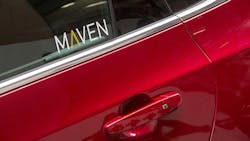
It’s been a big couple of weeks for GM’s efforts in the urban mobility space. After buying a $500 million stake in ride-sharing service Lyft and purchasing the assets of faltered car-sharing pioneer Sidecar for a relative song compared to that, the company announced today it is consolidating its car-sharing efforts under a new brand called Maven that it will roll out first at the University of Michigan in Ann Arbor.
The Maven team will include “40 dedicated employees from the connected car technology industry as well as ride- and car-sharing professionals from Google, Zipcar and Sidecar,” GM said in a statement today.
The services will be tailored to particular regions, and “include city, residential, peer-to-peer and campus programs.”
The initial rollout of the Ann Arbor service will include car-sharing for faculty and students at 21 parking spots across the city. A car-sharing service for Chicago residents will debut later in the first quarter of 2016, GM said, part of a partnership with developer Magellan group, builder of luxury condominium high-rises with projects currently in Chicago and Minneapolis.
Ian Beavis, chief strategy officer at automotive consulting agency AMCI, said that Maven “is basically General Motors' version of [car sharing service] ZipCar. “Maven is a way to unify several things they’re doing,” he said. “It’s an exercise. They’ve got a car sharing arrangement in Germany and one in New York. Coming up with a brand name for a car sharing service makes sense—putting it under an umbrella, giving it a focus, is a good idea.”
GM’s partnership with Magellan, he added, is “not exactly clear,” but “what I like about this is that it’s great experimentation, it’s helpful and valuable and it’s what car companies need to be doing. There’s no substitute for going out there and doing it, rather than just thinking about it.
“This peer-to-peer stuff, it’s going to be years before this shakes out. There won’t be one solution—there’s going to be multiple solutions.”
The Maven service will include an app to search for and reserve a vehicle and unlock the vehicle with a smartphone, as well as enable remote functions. Connected infotainment and safety services will be part of the package, providing, GM says, “an ownership-like experience” from a shared vehicle.
“With more than 25 million customers around the world projected to use some form of shared mobility by 2020, Maven is a key element of our strategy to changing ownership models in the automotive industry,” Julia Steyn, GM vice president of urban mobility programs, said in a statement.
About the Author
 Laura Putre
Laura Putre
Senior Editor, IndustryWeek
As senior editor, Laura Putre works with IndustryWeek's editorial contributors and reports on leadership and the automotive industry as they relate to manufacturing. She joined IndustryWeek in 2015 as a staff writer covering workforce issues.
Prior to IndustryWeek, Laura reported on the healthcare industry and covered local news. She was the editor of the Chicago Journal and a staff writer for Cleveland Scene. Her national bylines include The Guardian, Slate, Pacific-Standard and The Root.
Laura was a National Press Foundation fellow in 2022.
Got a story idea? Reach out to Laura at [email protected]