We’re Data Experts at Ford. Here’s How We See AI Agents Reshaping the Shop Floor.
Key Highlights
- We first look at the three waves of AI in manufacturing: machine learning solutions, generative AI and agentic AI.
- We then examine AI agents' strengths, weaknesses, opportunities and threats (SWOT) and make a business case for agentic AI in manufacturing operations.
- Finally, we look at the tangible impact of agentic AI on the shop floor.

The AI factory revolution has arrived, but it looks different than the passive analytics of the past decade. The industry is adopting AI agents capable of analyzing large datasets and underlying patterns, not just to predict but to also actively execute decisions.
It’s critical for decision-makers to understand we are moving from read-only engagement with data to a scenario where an agentic AI framework can analyze and make decisions to solve problems even before human operators are aware of them.
In this article, we look at the development of AI in an industrial setting and where agentic AI has the most impact, as well as the results we’ve seen on the shop floor.
From Dashboards to Decisions
The first wave of AI in manufacturing was about analytical reporting and visualization. Machine-learning solutions told you what could happen in the future based on insights gleaned from historical data patterns. Generative AI, the second wave, introduced the capability for AI to generate content and facilitate more natural interactions between humans and machines.
The third wave, agentic AI, represents a significant leap, where AI systems gain a degree of autonomy, capable of making decisions and taking action without direct human input.
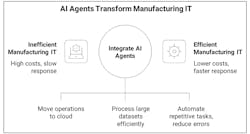
AI agents’ integration with enterprise applications and manufacturing execution systems enable them to work as individual team members. They process real-time data sets with less infrastructure overhead, utilizing the cloud’s auto-scale functions to make decisions in real time.
As noted by Microsoft CEO Kevin Scott in his discussion with AI entrepreneur Andrew Ng, AI is becoming a fundamental utility, much like electricity. But for manufacturers, the true value is not just being equipped with AI; it is about how agentic framework is utilized to solve real-world problems on a production line.
The Business Case: Strong Takeaways for Operations
The adoption of AI is not just an upgrade to the technology stack; it is a disruption to operational processes and cost structure. With the real-time decision-making process, manufacturers are seeing improvements in operational efficiency that were very difficult to achieve with rules-engine-based automation.
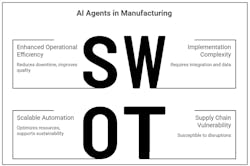
The figure below shows AI agents’ strengths, weaknesses, opportunities and threats (SWOT).
The key areas where AI agents are making a significant impact include:
Autonomous manufacturing operations: AI agents can oversee entire production processes, ensuring robotic systems operate at peak efficiency and managing deviations in schedules. They can handle most real-time decisions, with human workers intervening only for issues requiring judgment.
Predictive maintenance: By continuously monitoring machine performance and sensor data, AI agents can predict equipment failures before they occur. This allows for scheduled maintenance, which we have observed at our plants significantly reduced unplanned downtime by up to 40% and cut maintenance costs by 20-25%.
Quality control and defect detection: AI agents excel at real-time inspection, using machine vision, sensor fusion and anomaly detection to spot subtle defects that human inspectors might miss, especially in high-speed production. They can also adjust processes in real-time to correct issues, leading to a 30-50% reduction in defect rates.
Supply chain optimization: AI agents can predict and react to supply chain disruptions by monitoring raw material availability, adjusting production schedules, optimizing resource use and even identifying alternative suppliers. They streamline logistics, forecast demand and manage inventory, helping to avoid bottlenecks and material shortages.
Energy optimization and sustainability: Manufacturers can significantly reduce energy waste as AI agents monitor consumption across machines and make real-time adjustments to minimize usage without compromising production targets. From our observations the implementation of AI tools at our plants, this can lead to energy savings of 15-20% and supports green manufacturing objectives.
Process automation and optimization: Beyond traditional robotics, AI agents enable cognitive process automation by improving decisions and workflows that were previously manual or rule-bound. They can dynamically adjust parameters like temperature and pressure in real-time based on historical data, ambient conditions and input materials, leading to less waste, fewer mistakes and consistent quality.
Workplace safety: AI agents can monitor environmental factors and safety metrics on the factory floor, predicting potential hazards and automatically triggering safety protocols—such as shutting down machinery or alerting workers—to ensure safe operations.
Intelligent manufacturing assistants: These agents integrate design intelligence into the engineering process, using generative design algorithms to explore product variants, analyzing customer data to recommend product tweaks and evaluating manufacturability before prototyping.
End-to-end automation: Advanced "super AI agents" can manage complex, cross-functional tasks across the entire manufacturing process, from material procurement and production planning to quality control and shipment. They integrate data from all aspects of the supply chain and manufacturing floor to ensure seamless automation.
What Are the Tangible Impacts?
Below are the tangible impacts of agentic AI adoption we’ve determined based on recent implementations and industry analysis:
1. Reducing unplanned downtime: In the manufacturing world, predictive maintenance is the first step in their AI journey, but AI agentic frameworks take it further. Instead of identifying noise vibration anomaly, an AI agent can reference the inventory data and production schedules and schedule the maintenance window to minimize impact during changeovers.
Impact: During project implementation at our plants, AI agentic framework integrations show a reduction in unplanned downtime by up to 40%, with 20–25% savings in maintenance costs.
2. Live quality control: The manual inspection process and traditional machine vision are prone to flag false positives—incorrectly identifying a good product as defective. AI agents flag minute anomalies in fast-paced production that human operators miss. AI agents can scale and adjust to process parameters, temperature and speed in real time to fix anomalies before scrap is produced.
Impact: Anomalies reduced by 30–50%, significantly lowering the cost of quality.
3. Energy usage optimization: End-of-month sustainability reports are a lagging metric. Agentic AI framework considers energy as a variable, providing real-time data insights by monitoring consumption across machines, effectively optimizing resource utilization without impacting production targets.
Impact: AI solutions deployed on a cloud platform can result in 15 to 20% in energy savings, directly supporting green manufacturing objectives.
4. Supply chain agility: An agent can detect a raw material delay, identify an alternative supplier and propose a revised production schedule to the plant manager, all within minutes of the disruption.
Treating AI as Cost
Historically, IT expenses in manufacturing were viewed as overhead—a necessary evil. However, as Sam Altman notes in his blog Abundant Intelligence, we are entering an era where intelligence becomes a commodity.
Organizations that treat AI as a resource to optimize operations and execute decisions see gains. Tech giants like Microsoft, Google, and Oracle are already reshaping their platforms to support these agents. AI agentic framework can analyze and understand the underlying patterns, providing critical insights and reducing dependency on maintaining a large team of data professionals.
However, this requires a shift in culture. As NVIDIA points out regarding product design workflows, generative AI is transforming how we prototype and plan. Building trust in the AI framework with decision-makers is critical for the successful integration with manufacturing operations.
The Path Forward
For the effective utilization of AI, executives must:
- Focus on data quality: Quality data is critical for successful AI integration.
- Start with high-impact pilots: Focus on a specific pain point, such as energy waste or specific machine downtime, rather than trying to overhaul the entire ERP overnight.
- Prepare the workforce: As AI takes over routine decision-making, human roles must evolve toward supervision and strategy.
The era of the passive dashboard is ending. The future belongs to the active agent.
About the Author
Sanjay Ahire
Data Scientist, Ford Motor Co.
Sanjay Ahire, data scientist, Ford Motor Co., is a results-oriented leader with over 15 years of experience in data science and manufacturing process engineering. He has delivered complex global programs across the Aerospace and Automotive sectors, translating business strategy into impactful technology solutions.
Nagadithya Nookala
Technical Product Manager, Ford Motor Co.
Nagadithya Nookala leads full-stack and cloud-based AI product development with extensive experience in modernizing manufacturing operations through 13 years spent delivering advance analytics solutions using data-driven approach.