Drones Gain Altitude in Manufacturing Facilities (and Challenges Emerge)
Key Highlights
- Drones can inspect hard-to-reach assets and perform inventory scans with minimal disruption.
- Emerging payloads such as thermal sensors and lidar expand drone capabilities for predictive maintenance and hazard detection.
- Integration of drone data into enterprise systems like ERP, MES, and digital twins enhances decision-making and operational visibility.
- Addressing cybersecurity and data management challenges is critical for scaling drone programs securely and effectively.
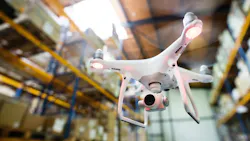
For manufacturing leaders navigating margin pressure, labor shortages and geographically dispersed assets, drones are becoming real business tools that can add valuable context and support. They provide clear value in areas such as inspection of elevated or confined assets and inventory tracking in large storage environments—activities that are traditionally labor-intensive, disruptive or difficult to perform safely.
As drone technology evolves, opportunities will expand. The greatest value will come not from the drones themselves, but from how the data they generate is integrated into maintenance, operations and decision-making processes.
Manufacturers that realize the greatest return on their drone programs establish enterprise-wide data governance, integrate drone data into operational systems and processes, align with cybersecurity standards and upskill their workforce to augment drone capabilities
Drones are making inroads in manufacturing in these two areas:
Inventory tracking: Autonomous indoor drones equipped with barcode scanners and computer vision systems can perform inventory scans with minimal disruption. In large warehouses or raw-material storage areas, they can significantly reduce cycle-count time and increase count frequency. The real-time data can be integrated into ERP and MES platforms, helping reduce working capital tied up in excess stock and decrease production delays due to stockouts.
Inspection: Conventional industrial inspections often require scaffolding, rope access, shutdowns or travel. They expose personnel to work-at-height, to work in confined spaces or to deal with environmental hazards.
Drones can transform this activity. High-resolution visual, thermal, ultrasonic and lidar payloads allow inspection of hard-to-reach areas, including storage tanks and silos, pipe racks and cable trays, roof structures and overhead utilities.
High-resolution payloads enable drones to serve as flexible machine-vision platforms, extending production inspection beyond fixed solutions.
Thermal payloads can identify unusual heat patterns in machinery or production lines, supporting earlier detection of manufacturing issues or equipment degradation. Assessments can be performed more frequently and consistently than with human inspections.
For remote manufacturing facilities, the financial impact is magnified. Every trip carries a cost and risk. A drone mission can eliminate days of logistics and increase safety performance.
In regulated industries—such as food and beverage, pharmaceuticals, energy, chemicals and utilities—timestamped and georeferenced drone data can strengthen compliance documentation and audit readiness.
The business impact is measurable: reduced downtime, lower mobilization costs, reduced safety risk and faster response to anomaly detection.
In the energy and utilities sector, drone-based inspection has been estimated to reduce inspection costs by up to 70% and downtime by up to 90%. Other studies have demonstrated cost and safety benefits, including reduced exposure to dangerous atmospheres and faster detection and response to inspection anomalies.
While the extreme remoteness of certain assets is more prevalent in those industries, manufacturers can still see benefits in their operations.
Emerging Developments
Payloads
The evolution of drone payloads is accelerating their strategic importance. Beyond conventional RGB [red-green-blue or color] cameras, modern platforms may carry thermal infrared sensors, lidar scanners, ultrasonic thickness measurement devices, gas detection sensors, radiation monitoring sensors and acoustic sensors for partial discharge detection.
Digital twins
Drones and their data are now contributing to the development of digital twins. High-resolution photogrammetry and lidar payloads generate continuously updated spatial models of facilities.
For geographically dispersed manufacturing sites, a current digital twin reduces the need for physical presence. Engineers and subject-matter experts can assess conditions and validate design modifications remotely. They can rehearse work scopes and conduct hazard analysis prior to work, and they can also support incident investigation after the fact. When travel costs are high or weather windows narrow, the financial savings compound rapidly.
Future innovation
The next stage in drone deployment is autonomous operation. Drones will increasingly operate from fixed docking stations, launching automatically to perform scheduled inspection missions. Data collected during these flights can be transmitted to AI-enabled analytics platforms and integrated into operational systems in near real-time.
As these capabilities mature, coordinated drone swarms may be used to conduct large-scale inspections and surveys across extensive infrastructure
At the same time, innovations are emerging within the drone platforms themselves. Onboard edge AI processing enables drones to analyze data in flight, enabling real-time defect detection, automated anomaly scoring and faster identification of conditions requiring maintenance or further investigation.
Challenges
Manufacturers need to be aware of potential roadblocks to scaling drone programs and be prepared to deal with them.
Augmentation, not replacement
Concerns about workforce displacement are common, and the increased adoption of drones is no exception. In practice, drone programs typically augment skilled labor rather than replace it. Technicians can become certified drone pilots, remote inspection specialists, data analysts or AI-assisted defect reviewers.
For manufacturers with geographically diverse facilities, the ability to remotely pilot a drone reduces physical effort and travel time while enabling more frequent inspections and richer data. Scaling responsibly, however, requires structured training, clear operating procedures and integration with maintenance workflows. With such planning, drones can elevate an organization’s capability.
Cybersecurity
Modern industrial drones are connected devices. They transmit high-resolution imagery, store geospatial infrastructure data and interface with cloud platforms and enterprise asset systems. As such, they must be treated as operational technology nodes within the broader cybersecurity architecture.
A compromised drone platform presents a risk that goes beyond simple device failure. It may expose critical infrastructure data or provide a means to traverse and compromise enterprise or OT networks.
Manufacturers and operators should align with recognized frameworks such as the International Society of Automation’s ISA/IEC 62443 series for automation and control system security, as this defines the approach to managing the cyber-physical risks associated with operational technology.
Key security controls include secure firmware management, encrypted communications, identity and access management and network segmentation.
Data integration
Not so long ago, the greatest challenge with drones in industrial environments was flight safety. Today, it is data isolation. Drone programs deliver lasting enterprise value only when their outputs are integrated into core operational systems.
Key integration points include enterprise asset management (EAM) systems, computerized maintenance management systems (CMMS), GIS systems and environmental and compliance monitoring systems. Organizations now also have to consider digital twin platforms and AI-based defect-detection engines.
To scale across an organization, leaders must define standardized data formats and metadata tagging convention requirements for the data being collected. They must also define the storage architecture and lifecycle management for this data, as well as secure protocols for data interchange between stakeholders across their supply chain.
A fully scaled drone program that makes good use of its data is a significant strategic asset.
About the Author
Steve Mustard
President and CEO, National Automation Inc.
Steve Mustard is an industrial automation consultant with extensive technical and management experience across multiple sectors. Backed by 30 years of engineering experience (and numerous professional engineering credentials), Mustard specializes in the development and management of real-time embedded equipment and automation systems and cybersecurity risk management related to those systems.