Cobots Handle Furniture-Making Drudgery, People Focus on Company Growth
Key Highlights
- Another example of how robots don't actually take away jobs.
- Why you shouldn't necessarily depend on turnkey solutions.
- How the cobots provided quick ROI.
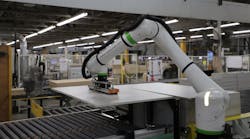
Robots didn’t take anyone’s job at furniture-maker Foliot because the things that machines excel at doing aren’t the jobs that people want.
Based in Saint-Jérôme, Quebec, Canada, Foliot primarily makes furniture from laminate. Like many producers, it had trouble finding operators with the right profile—the capacity to understand complex equipment who also didn’t mind repetitive tasks.
“We realized that automating some of these operations would be a very good solution, because we could keep the good operators and the people that [have] the right skills to overview these cells,” says Simon Perreault, vice president of operations. “Instead of being just a panel processor they’d be supervising fully automated cells.”
The company believes in investing in new technologies. In the early 2000s, Foliot installed its first fully automated panel processing line with edge benders and saws and, for many years, that met the company’s needs. Then markets and products evolved.
In 2023, Perreault had to convince a lot of people to spend millions of dollars on a fleet of just released CRX-30 cobots from Fanuc, if a pilot deployment at the Saint-Jérôme plant succeeded.
“My CFO, my CEO, my owners, the members of the board, then, when we got a green light, we had to convince our employees,” Perreault says. Despite the company’s earlier efforts to embrace technology, “We thought that there would be resistance to change… We felt that some employees could fear this new technology coming and replacing them.”
Instead, employees welcomed the relief from the dull and dirty task of feeding laminate panels into edge bender and CNC machines. After a successful pilot, Foliot installed 11 units at the Saint-Jérôme plant and scaled to its facility in Las Vegas, Nevada.

You Need Programmers if You Don’t Go Turnkey
If Perreault could do the first installations over again, he’d hire an experienced programmer before anything else.
“We have very smart operators and smart employees, but the skills necessary to [program a robot], even if it’s little blocks [on a user-interface screen] that you drag and drop, you still need a structure in programming,” Perreault says. “When we hired a technician, a programmer, someone that had experience already with [integrating cobots], the speed and the quality of our deployment just went up tremendously.”
Foliot could have gone with a turnkey solution, but Perreault wanted to build a knowledge base. He knew his team could tackle these sorts of projects internally and wanted them to learn the programming the hard way, to enable expansion without having to lean on integrator Vention exclusively.
“There’s a lot of little pieces of software necessary to pilot all these, these components… We should have invested a little bit more in better understanding of all these little parts,” says Perreault.
Connecting all the different makes and models of machines on the floor to the cobots also provided a challenge. Not all equipment manufacturers provided electrical schematics for low-voltage interconnections. He eventually got the information from the manufacturers, but things would have gone a lot easier had Perreault gathered the info well before the installation.
Fast ROI Drives Cobot Scaling
The Saint-Jérôme plant’s cobot fleet grew to 20 units in 2026 and the Las Vegas plant currently runs 13 units, with installations continuing on edge benders and CNC machines. Perreault says it’s more of a copy and paste project now.
At the Saint-Jérôme plant, operators shifted from the newly automated panel tending stations to new lines at the plant and the machines running the new cobots showed a 15% increase in throughput.
“We had less accidents. We had a few per year in the past, but since we implemented these cobots, none at all on these cells,” says Perreault.
Employee retention also improved. Foliot hasn’t lost any operators since the cobot installations.
According to Perreault, the cobot investment paid for itself in around 16 months.
“Try to find projects with pay back close to a year. These days, they’re hard to find,” he says.
About the Author
 Dennis Scimeca
Dennis Scimeca
Dennis Scimeca is a veteran technology journalist with particular experience in vision system technology, machine learning/artificial intelligence, and augmented/mixed/virtual reality (XR), with bylines in consumer, developer, and B2B outlets.
At IndustryWeek, he covers the competitive advantages gained by manufacturers that deploy proven technologies. If you would like to share your story with IndustryWeek, please contact Dennis at [email protected].