Industrial Humanoid Robots: Are We Even Talking About the Same Thing?
Key Highlights
- CES 2026 was awash in walking, lifting, interacting machines. But robots that actually look human aren't necessary in industrial settings.
- The focus is shifting from humanoid appearance to capabilities such as mobility, perception, and autonomous decision-making driven by physical AI.
- Industrial humanoids serve as data-gathering platforms that enhance automation and provide strategic advantages in digital industrial ecosystems.
- Key players like NVIDIA, Boston Dynamics, and Siemens are advancing Physical AI to enable autonomous, adaptable robots that operate seamlessly in complex environments.
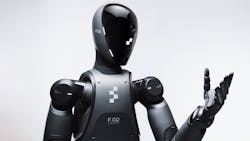
Humanoid robots have firmly entered mainstream conversation. CES 2026 made that unmistakable. Walking, lifting, interacting machines dominated exhibition halls, reinforcing the impression that humanoids are ready to move beyond demos into real industrial environments.
This perception was amplified by a series of announcements in early 2026:
BMW and Figure AI: Figure 02 humanoids ran 10-hour shifts on the BMW X3 line, loading sheet-metal parts. By 2026, they had supported 30,000 vehicles and handled 90,000 parts.
Unitree Robotics: Showcased humanoid platforms (G1, H2, R1) at CES 2026, emphasizing modularity, affordability and scalability for research and early commercial use. Dynamic demos highlighted motion control, balance and perception.
Tesla Optimus: Training began at Austin’s Giga factory using imitation learning. Optimus already performs simple tasks, with more advanced capabilities expected by year-end.
Boston Dynamics and Hyundai: Atlas was unveiled in a production-ready form, signaling a shift from prototypes to field-oriented systems. Hyundai plans to produce tens of thousands of units annually by 2028.
Humanoid and Siemens: Completed a proof of concept for logistics tasks, such as destocking and tote transport.
Humanoid and Schaeffler: Announced a five-year partnership to deploy hundreds of humanoids into production facilities starting in 2026–2027.
Boston Dynamics and DeepMind: Gemini Robotics AI will enhance Atlas’s perception and industrial task execution.
Qualcomm: Entered humanoid robotics with compute platforms for autonomous motion and perception.
NVIDIA: Released Physical AI models, simulation frameworks, edge-to-cloud pipelines and energy-efficient compute for autonomous robots.
Together, these developments suggest that humanoids are no longer a novelty. But are we even talking about the same thing when we say “industrial humanoid”?
Social vs. Industrial Humanoids
Public discourse often conflates all humanoids. In social settings such as healthcare, elderly care and hospitality, a human likeness is essential. Facial expressions, posture, gestures and voice are functional requirements that support trust and interaction.
Industrial settings, however, are different. Many assume industrial humanoids should look like humans, move like humans and perform tasks like industrial robots, just with legs. This assumption drives unrealistic expectations and skepticism.
Compared to humanoids, industrial robots are deterministic, more precise, more reliable and safer. They can be mobile, collaborate with humans and perform high-volume tasks efficiently. Evaluating humanoids as replacements for industrial robots sets them up for inevitable failure.
The core issue is that humanoids are not industrial robots yet. Efficiency should not be judged by two legs, two arms and a head. Why not one arm, or three? Why a head at all? Sensors can be placed anywhere. The human-like form creates expectations that humanoid robots will behave like humans. However, they are not there yet.
Humanoids as AI-driven Platforms
A better framing is to see industrial humanoids as mobile, sensor-rich, AI-driven platforms. Manipulation and locomotion are part of the value, but the real advantage is their ability to move freely in human-designed spaces, observe continuously and contextualize data in real time.
Humanoids can even collect data 24/7—temperatures, vibrations, visual anomalies, movements and environmental changes. This data can be analyzed locally or integrated into ERP, MES, maintenance, quality or service systems. Hence, humanoids on the shop floor complement automation rather than compete with it.
Physical AI: the Missing Concept
Physical AI refers to AI systems that perceive the physical world and can reason in real time –and can act autonomously based on those capabilities. It is the brain and nervous system of embodied machines. NVIDIA is the most visible proponent, investing in GPU-accelerated perception, simulation, robotics foundation models and large-scale training. Then, what truly differentiates humanoids from traditional robots is autonomy, not dexterity.
Beyond Productivity: Strategic Technology
Adding another perspective to the thoughts above, industrial humanoids are more than pure productivity tools. Physical AI underpins dual-use technologies including autonomous vehicles and drones. Control over AI models, training data, compute infrastructure and the full hardware-software stack increasingly defines technological leadership. Humanoid robotics is intertwined with the AI race between the U.S. and China, with training on real-world physical data emerging as a geopolitical capability.
Rethinking the Question
With that, my advice would be not to mix up industrial humanoids with those designed for social use. Also, do not expect industrial humanoids to replace industrial robots at the same speed and scale. Their value lies less in replacing robotic arms and more in their potential to operate autonomously, adapt to changing environments and generate rich data about the physical world—capabilities that conventional automation cannot easily deliver.
The future of industrial humanoids does not seem to be decided by how human-like they look. It will be determined by the maturity of physical AI; the integration of mobility, perception, and autonomy; and connection to digital industrial platforms.
The critical question is not “Can humanoids replace industrial robots?” It is:
What becomes possible when AI gains a body that can move, sense and act in the real world?
When we ask this, the conversation finally shifts from hype to substance.
About the Author
 Jan Burian
Jan Burian
Global Analyst
Jan Burian is a global analyst, author, and speaker. His expertise spans digital transformation, management, leadership, and the geopolitical influences shaping manufacturing and global supply chains. Jan led Manufacturing Insights Europe at IDC and held consulting positions at EY and Deloitte.