The Strategy Flaw That’s Killing AGV & AMR ROI
Key Highlights
- Manufacturers often deploy AGVs and AMRs without planning for the automation of human decision-making, leaving robots without the context needed to complete complex and dynamic tasks.
- Effective orchestration translates human decision‑making into system logic, allowing robots to prioritize work, handle exceptions, and respond to real‑time conditions without manual intervention.
- Interoperability gives every robot access to shared data, priorities, and status updates, enabling mixed fleets to coordinate smoothly and operate safely within the same physical space.
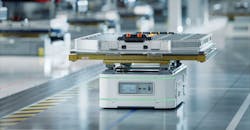
Ongoing labor shortages are forcing manufacturers to rethink how they operate and accelerating the need for end-to-end automation. When it comes to material movement, that often means deploying Automated Guided Vehicles (AGVs) and Autonomous Mobile Robots (AMRs) to take on tasks once handled by people.
Unfortunately, many of these deployments will fail to achieve the long-term ROI leaders expect.
These ROI gaps rarely stem from the robots themselves. The biggest misstep happens long before an AGV or AMR reaches the plant floor. It happens during strategy development when teams fail to plan for the automation of human decision‑making.
The ROI Killer: Human Decision-Making
In almost every production environment, human workers make continuous, situational decisions that keep operations running smoothly. They adapt to unexpected delays, prioritize tasks based on context, navigate around obstacles, and communicate with other teams. This type of dynamic decision‑making is often invisible because it’s so natural to humans.
However, robots act strictly on the instructions and data they receive. When manufacturers overlook the human decision points embedded in daily operations, robots are forced to operate without context, making it difficult for them to handle complex and dynamic tasks.
A few years ago, Flexware Innovation partnered with a rolled goods manufacturer that was encountering this challenge. Their AGVs were tasked with feeding production equipment, stocking WIP areas, removing scrap material, and delivering finished goods to designated shipping areas. However, the automation plan didn’t account for the nuanced decisions operators made to keep materials moving. As a result, the robots weren’t notified when rolls were ready, and they couldn’t route materials dynamically based on real‑time demand. This meant the fleet could only perform basic movements and required frequent human intervention.
Deployments like this reveal an important fact: robots can replace labor, but only when the decision‑making operators use every day is translated into logic and supported with the right data.
Turning Human Judgment into Executable Logic
If the gap is human decision‑making, the remedy is to capture that logic and make it executable. One practical way to do this is through orchestration, or the strategic coordination of robots, equipment, software, and people.
Effective orchestration requires a control layer. This layer provides a single environment to plan, schedule, and monitor tasks. With this foundation in place, you can define the rules and exceptions that direct work based on location availability, robot status, inventory priorities, and more.
The final step is then to integrate the robots with other key systems (WMS, ERP, MES, conveyors, scanners, doors, etc.) so they receive the real-time data and updates required to act with full context.
Ultimately, orchestration is what transforms individual robots into a cohesive, intelligent operation.
Enabling Communication Across Mixed Fleets
Humans naturally read cues on the floor like noticing someone approaching and stepping aside to let a higher‑priority load pass. Automated vehicles, however, can’t make those judgment calls on their own. To achieve true interoperability, they need clear rules and real‑time communication with the systems around them.
This can be difficult to accomplish in plants that have fleets from multiple vendors. Each vendor uses its own maps, protocols, and operating logic, creating major interoperability challenges because the robots can’t communicate with one another. Without the ability to coordinate these mixed fleets, manufacturers face delays, inefficiencies, and in the worst cases, deadlocks. Deadlocks occur when two vehicles get too close to each other, triggering their safety features. This causes them to freeze in place until they are manually unlocked.
To solve this problem, manufacturers must integrate the fleet‑management software from both vendors. Once that foundation is established, centralized mission planning and unified priority rules can be applied across all fleets.
When interoperability is achieved, mixed fleets move from competing for space to collaborating seamlessly, delivering the throughput gains automation promises.
Building a Better Deployment Strategy
As you can see, building an effective AGV and AMR deployment strategy begins with a deliberate plan for how human decision‑making will be translated into systems logic. And to achieve this, you will need thoughtful orchestration supported by strong interoperability. When you plan for this from the start, you can create an environment where every system shares context, follows consistent rules, and operates from a unified source of truth.
After building this strategy, the next question is inevitably: How will we execute this at scale? For many manufacturers, the answer is to implement an intralogistics platform. This technology provides a centralized environment for coordinating robots, equipment, and enterprise systems. Its extensibility—allowing new vehicles, technologies, and workflows to be added without rework—makes it significantly more sustainable than custom coding. By adopting an intralogistics platform, manufacturers can reduce the risks associated with AGV and AMR deployments and establish a scalable foundation for long‑term operational growth.
With a scalable strategy in place, your robots can begin to operate with the same clarity and coordination that humans bring naturally. And more importantly, you start to see the sustained ROI that automation initiatives are designed to deliver.
Sponsored By:

About the Author
Brice Bucher
VP of Products, Flexware Innovation
Brice Bucher is an accomplished product and technology leader with over two decades of experience spanning product management, systems integration, and business intelligence. As Vice President of Products, he leads the strategy and execution of Flexware’s product portfolio, including the development and advancement of Flexware’s intralogistics platform, LIFT.