Now Interacting: Robotics and AI in Manufacturing
Key Highlights
- AI-driven adaptive robotics will replace rigid, hard-coded systems, enabling quick reconfiguration for high-mix, low-volume production without extensive reprogramming.
- Warehouse automation will evolve from task-specific robots to decision-aware systems that dynamically prioritize tasks and optimize workflows based on real-time operational data.
- AI will serve as the unifying intelligence layer, linking various manufacturing systems and data sources to improve predictive maintenance, quality control, and overall efficiency.
- Human-robot collaboration will become more prevalent, with AI interfaces translating natural language and gestures, making automation accessible to smaller manufacturers.
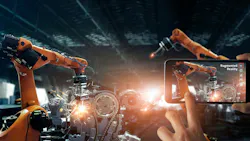
Manufacturing is approaching a turning point where robotics and AI are no longer treated as different entities. Instead, the two are interacting to change how factories operate, scale and compete.
According to "The Impact of Technology in 2026 and Beyond: an IEEE Global Study," 52% of technologists expect robotics to be among the areas most influenced by AI, while 35% cite supply chain and warehouse automation as top AI use cases.
These numbers reflect some of the challenges that factory floors face worldwide: operating with fewer workers, less downtime and tighter margins in an environment of persistent labor shortages and supply chain volatility.
AI-powered robotics are not only emerging as a futuristic vision, but as a response to these challenges.
Adaptive Robotics Replaces Hard Coding
Traditional industrial robots excel at repeatability. They are fast, precise and reliable, but also rigid. Any change in product mix, part geometry or process flow typically requires reprogramming, downtime and specialized engineering support.
AI changes that equation.
The shift from hard-coded automation to adaptive robotics will be largely driven by recent advances in AI-enabled vision systems, lower-cost compute at the edge and growing pressure to support high-mix production. These capabilities allow robotic systems to perceive, reason and adjust in near real time, reducing the need for extensive reprogramming every time a product or process changes.
Machine vision powered by deep learning will allow robots to identify variable parts without custom fixtures. Reinforcement learning will enable robots to optimize paths and motions based on real-world feedback rather than predefined scripts.
This is especially impactful in high-mix, low-volume manufacturing, where traditional automation struggles to justify ROI. AI-enabled robots have the potential to optimize the economics of manufacturing flexibility, increasing the viability of automating processes that were previously left to manual labor due to variability.
The result is not fewer but smarter robots that can be redeployed across tasks and product lines, extending asset life and accelerating payback periods.
For example, a robotic cell used for palletizing packaged goods during one production shift could be reconfigured through AI-assisted vision and motion planning to handle kitting or material handling tasks for a different product line later in the day—without the extensive reprogramming that traditional automation typically requires.
The Rise of Intelligent Supply Chains and Warehouses
Within the next three to five years, warehouse automation is expected to evolve from task-oriented robotics (pick, place, move) to decision-aware systems capable of dynamically adjusting priorities based on operational conditions.
Though some advanced distribution centers use autonomous mobile robots (AMRs) for individual tasks, progress in AI orchestration will allow robotic fleets to shift from isolated workflows to operate across production, inventory and shipping.
For instance, if a high-demand product suddenly spikes in orders, AI systems can reroute AMRs to prioritize high workflows while temporarily deprioritizing lower-volume materials, reducing bottlenecks and maintaining throughput during demand fluctuations.
AI may also enable predictive orchestration by anticipating bottlenecks before they occur. For instance, when shipment or production delays arise, robotics could adjust picking strategies in real time to reduce inventory imbalances.
This intelligence becomes particularly important as manufacturers increasingly adopt regionalized and reshored supply chains and have to adapt quickly to challenges in their new locations.
AI as the Brain of the Factory
The most significant transformation will be AI acting as a unifying intelligence layer, linking robotics to an expansive manufacturing ecosystem that includes unused or underused data from machines, sensors, quality systems and enterprise platforms.
This unifying layer has the potential to improve predictive maintenance, with AI models analyzing vibration, torque and thermal data from robots to forecast failures before they occur. Additionally, real-time feedback loops will allow inspection data to correct robotic motion and processes as issues arise. And digital twin models of robotics cells can prompt production changes before they are implemented on the shop floor, streamlining the process.
This AI nervous system will coordinate people, machines and processes to help improve efficiency and safety.
Human-Robot Collaboration Takes Center Stage
AI-enabled robotics will also support collaborative manufacturing, or humans and robots working side by side. Human operators are able to interact with these robots—mainly cobots—through AI-powered interfaces that translate natural language, gestures and visual clues, lowering the barrier to automation adoption.
Operators will not need to be robotics experts to reassign tasks and workflows. Instead, AI-driven abstraction layers will translate human intent into robotic action, making automation more accessible for small and medium-sized manufacturers with limited resources to hire specialists.
Importantly, this also changes workforce strategy. Manufacturers will place greater value on robotic supervision, systems thinking and data literacy in training and hiring.
Looking Ahead to 2026 and Beyond
In 2026 and beyond, manufacturing innovation will no longer be defined by how automated a factory is but by how intelligent it is. While robotics will provide the physical capability, AI will provide the cognitive layer.
Together, they will create manufacturing systems that are flexible, resilient and continuously improving.
The manufacturers that embrace this convergence early will not just increase efficiency, but they will redefine what operational excellence looks like in the next decade. As I often tell industry leaders: automation moves faster; intelligence moves smarter. The future belongs to those who combine both.
About the Author
Bhushan Patel
Principal Technical Program Manager, Robotics, Intuitive
Bhushan Jayeshkumar Patel is an IEEE senior member with over a decade of experience bringing complex, regulated technologies from concept to commercialization. His expertise spans industrial and surgical robotics, AI-enabled automation, and large-scale product development, with a focus on operational excellence, design assurance, and systems integration. Bhushan is a frequent contributor to industry publications and expert panels, where he writes on the intersection of robotics, artificial intelligence, and manufacturing innovation.