US Pulls Trigger on China Tariffs; China Retaliates as Trade Furor Mounts
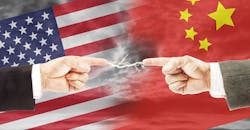
U.S. President Donald Trump fired the biggest shot yet in the global trade war by imposing tariffs on $34 billion of Chinese imports. China retaliated.
Duties on Chinese goods started at 12:01 a.m. Friday in Washington, just after midday in China. Another $16 billion of goods could follow in two weeks, Trump earlier told reporters, before suggesting the final total could eventually reach $550 billion, a figure that exceeds all of U.S. goods imports from China in 2017.
U.S. customs officials will begin collecting an additional 25% tariff on imports from China of goods ranging from farming plows to semiconductors and airplane parts. China has said it would respond by imposing higher levies on an equivalent amount of goods ranging from American soybeans to automobiles, which may in turn prompt Trump to raise trade barriers even higher.
China’s tariff actions in response took effect at 12:01 p.m. in Beijing, state news agency Xinhua reported, citing an unidentified official from the General Administration of Customs.
“The United States has violated WTO rules and ignited the largest trade war in economic history,” China’s Commerce Ministry said in a earlier statement. “Such tariffs are typical trade bullying, and this action threatens global supply chains and value chains, stalls the global economic recovery, triggers global market turmoil, and will hurt more innocent multinational companies, enterprises and consumers.”
European stocks gained after a rally in Asian shares buoyed sentiment, even as China put in place its response to well-telegraphed U.S. trade tariffs. Havens headed lower.
No Obvious End to Conflict
The riskiest economic gamble of Trump’s presidency could spread as it enters a new and dangerous phase by imposing direct costs on companies and consumers globally. It’s the first time the U.S. has imposed tariffs aimed just at Chinese goods and follows months of accusations that Beijing stole American intellectual property and unfairly swelled America’s trade deficit.
"Clearly the first salvos have been exchanged and in that sense, the trade war has started. There is no obvious end to this," said Louis Kuijs, chief Asia economist at Oxford Economics.
As the world’s most developed nation and the rule-maker of the current global governing system, there is "astounding absurdity" in the U.S. complaining that it’s been bullied in trade, the People’s Daily, the flagship newspaper of the Communist Party of China, said in a Chinese language commentary on Friday.
How China could hurt U.S. businesses in China
Trump is doubling down on his promise to put “America First” in the nation’s foreign and economic policies. He blames China for a bilateral trade deficit of $336 billion and for costing U.S. manufacturing jobs.
The tariffs could jeopardize a U.S. economic upswing that has extended to nine years and pushed the jobless rate to the lowest in nearly half a century. U.S. and Chinese companies will now find it costlier to trade with each other, meaning less demand and higher prices. The International Monetary Fund warns an extended spat could undermine the strongest global expansion since 2011.
Risk to Growth
The extent of the economic damage will depend on how far both sides go. If the U.S. and China cool off after a first round of tariffs, the impact on their economies will be modest, according to Bloomberg Economics. Under a full-blown trade war in which the U.S. slaps 10% tariffs on all other countries and they respond, the economists reckon U.S. growth would slow by 0.8 percentage point by 2020.
The impact of the first round of tariffs on $34 billion in Chinese goods will be “quite small,” said Ethan Harris, head of global economic research at Bank of America Merrill Lynch. But he doesn’t “see the war ending until there are casualties.”
JPMorgan Chase & Co. economists warn the biggest risk may come from the indirect impact of tightening credit conditions and business confidence, reducing scope for investment and hiring while undermining financial markets.
Economic Model
Beijing has shown little interest in making fundamental changes to its economic model. Xi has balked at U.S. demands to stop subsidizing Chinese firms under his plan to make the nation a leader in key technologies by 2025. Negotiations between the two countries petered out with the Chinese accusing the U.S. of blackmail.
The U.S. imports much more from China than the reverse, giving the U.S. an advantage in a tariff dispute. That means that if the dispute deteriorates, Beijing will run out of products to impose tariffs on much faster than the U.S., and so might retaliate against American companies operating in China. It could even take the drastic steps of devaluing the yuan or reducing its $1.2 trillion holdings of U.S. Treasuries, measures that would hurt it as well as the U.S.
In the past, the U.S. used its economic clout to win trade skirmishes with developing countries, said James Boughton, a senior fellow at the Centre for International Governance Innovation in Waterloo, Ontario. China, whose economy has grown tenfold since it joined the World Trade Organization in 2001, poses a much more formidable adversary.
“The dynamic is different from anything we’ve seen,” said Boughton. “China has an ability to ride out this kind of pressure, to weather the storm, that a lot of countries didn’t have in the past.”
By Bloomberg News
About the Author
Bloomberg
Licensed content from Bloomberg, copyright 2016.