US Fed Holds Interest Rates Steady, Defying Trump Pressure
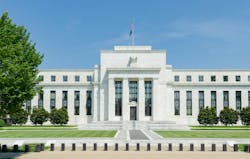
The U.S. Federal Reserve held interest rates steady Wednesday at its first policy gathering this year, citing robust economic growth, as the central bank resists President Donald Trump's mounting pressure for cuts.
The Fed's 10-2 vote maintains rates at a range between 3.50% and 3.75%, an outcome that was widely expected as officials await more data on the world's biggest economy.
Response from Manufacturing Group:
“With tension between the two sides of the dual mandate and a policy rate nearing estimates of the neutral rate, we can expect the Federal Reserve to proceed cautiously until economic data dictates a clear path. The historically strong demand for manufacturing technology at the end of 2025 indicates that interest rates are not suppressing demand for manufactured goods, and the companies making those products and parts can comfortably make the capital investments necessary to meet that demand.”
—Christopher Chidzik, principal economist of AMT – The Association For Manufacturing Technology.
But the Federal Open Market Committee saw two dissents.
Fed Governor Stephen Miran, alongside Christopher Waller -- who is seen as a potential candidate to succeed chairman Jerome Powell -- both backed a quarter-percentage-point rate cut instead.
The Fed has made quarter-point cuts at its last three policy meetings, as officials worried about the cooling jobs market. Miran, who was recently appointed by Trump, pushed for larger reductions each time.
But solid GDP growth, relatively low unemployment and stubborn inflation have provided reasons to pause, putting officials again at odds with Trump, who has repeatedly urged for lower interest rates.
Trump has sharply escalated pressure on the Fed since returning to the White House a year ago, taking steps that officials warn could threaten the bank's independence from politics.
The president has been seeking to oust Fed Governor Lisa Cook over mortgage fraud allegations, while his administration launched an investigation into Powell over the bank's headquarters renovation.
In a rare rebuke this month, Powell criticized the threat of criminal charges against him, saying this was about whether monetary policy would be "directed by political pressure or intimidation."
Higher Bar
"While the Fed has been politically pressured to cut rates, it is not pressed by the data," said EY-Parthenon Chief Economist Gregory Daco.
Officials appear to have converged on a near-term halt in rate reductions, with their debate now centering around what conditions justify further cuts -- and how quickly these should take place.
"The hurdle for additional near-term cuts has risen," Daco said.
Officials will be looking for "clearer, more durable evidence of disinflation" or renewed deterioration in the labor market before lowering rates again, he added.
Recent weakness in the U.S. dollar could cause further complications, making imported products more expensive for American consumers who are already hit by higher prices as Trump's tariffs flow through supply chains.
Financial markets generally expect the Fed to continue keeping rates unchanged until its June meeting, according to CME FedWatch.
Looking ahead, all eyes are also on how Trump's nominee to succeed Powell -- whose chairmanship of the bank ends in May -- shapes Fed policy.
"We think inflation peaks and starts to turn lower (this year) but also importantly, we think a new Fed chair would be more open to helping to navigate lower interest rates," said Nationwide Chief Economist Kathy Bostjancic.
Credibility Issues
One issue is whether the new chairman can corral the rest of the rate-setting committee into more cuts, ING analysts said.
Outside the Fed, it could be harder for the next chairman to convince investors that the bank will continue pursuing its mandate of low and stable inflation and maximum employment, independent of political influence, said Michael Strain of the conservative American Enterprise Institute.
Given the way the Trump administration has targeted Powell, Strain added that "establishing credibility will be much more challenging" for Powell's successor than previous Fed chiefs over the last few decades.
Strain, who is AEI's director of economic policy studies, also cautioned that the Fed may have gone too far in lowering rates last year.
He warned that the labor market might be stronger than officials think, while there remains a risk that inflation accelerates again.
"Certainly, the Fed should not continue to cut," he said. "I'm worried the Fed's going to have to hike in 2026."
All rights reserved ©2026 Agence France-Presse
About the Author
Agence France-Presse
Copyright Agence France-Presse, 2002-2026. AFP text, photos, graphics and logos shall not be reproduced, published, broadcast, rewritten for broadcast or publication or redistributed directly or indirectly in any medium. AFP shall not be held liable for any delays, inaccuracies, errors or omissions in any AFP content, or for any actions taken in consequence.