Tesla Capex Plans Balloon by Another $5 Billion
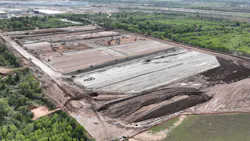
Executives of Tesla Inc. said April 22 they now will spend about $25 billion this year on the company’s various capital projects, a jump of roughly $5 billion from the plans they outlined in late January.
Speaking to analysts and investors after Tesla reported first-quarter net profits of $477 million, CEO Elon Musk and CFO Vaibhav Taneja reiterated their vision to more vertically integrate Tesla as they build capacity to produce Optimus robots alongside (increasingly autonomous) electric vehicles and energy generation and storage products. That, they said, will require large and simultaneous investments in batteries, AI software and hardware, and semiconductor factories.
“We just anticipate hitting a wall if we don’t make chips ourselves,” Musk said about the last of those priorities while noting that Tesla isn’t looking to create leverage over its chip suppliers. “We do have some ideas for how to make maybe radically better AI chips […] If the long shot pays off, it’s maybe a giant improvement and it’s just easier to do that if we have our own research fab and are developing our own production technologies. If you look sort of long term at, say, having AI satellites [and] making chips for those, there’s just no way […] the existing industry can keep up with that. It’s impossible.”
Tesla’s capex boom means it will spend more this year than in 2024 ($11.3 billion) and 2025 ($8.5 billion) combined. Taneja said six plants will go into operation this year and next, and the company also is investing in projects such as its Cybercab, the Semi heavy-duty truck and the Megablock battery storage system as well as chips and Optimus.
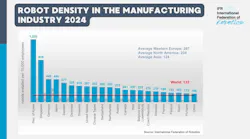 Bar chart showing robot density in manufacturing in 2024
 dreamstime_m_113626186
Among the projects near the front of Tesla’s queue is building capacity to make Optimus robots. Production lines at the company’s Fremont, California, plant that have been making Model S and Model X cars will soon be converted to make about 1 million robots annually. In addition, Tesla teams have started work on a facility in Texas that executives say will grow to be able to produce 10 million robots annually.
On the conference call, Musk said near-term Optimus production will focus on being able to increasingly test the robots inside Tesla facilities. But, he added, he expects that the company will “probably [be] able to have Optimus be useful outside of Tesla sometime next year.”
On the vehicle side of Tesla’s business, Taneja noted that demand improved in the first quarter, including in the United States, where Tesla’s deliveries rose slightly from late last year. He added that the jump in gas prices due to the Iran war has led to orders climbing but also noted that more buyers were coming to Tesla before energy costs spiked, something he attributed to the company “bringing more compelling and affordable vehicles to market.”
During the first quarter, Tesla produced about 408,000 vehicles, which was 13% higher than in early 2025 but down from 434,000 in the fourth quarter. The company delivered 358,000 vehicles to customers during the period, a year-over-year increase of 6%.
Shares of Tesla (Ticker: TSLA) initially rallied on the earnings report but gave up those gains during the conference call. Around midday on April 23, they were changing hands around $378, down more than 2% from their previous close. Over the past six months, they have lost about 17% of their value, a slide that has trimmed Tesla’s market capitalization to about $1.4 trillion.
About the Author
Geert De Lombaerde
Senior Editor
A native of Belgium, Geert De Lombaerde has been in business journalism since the mid-1990s and writes about public companies, markets and economic trends for Endeavor Business Media publications, focusing on IndustryWeek, FleetOwner, Oil & Gas Journal, T&D World and Healthcare Innovation. He also curates the twice-monthly Market Moves Strategy newsletter that showcases Endeavor stories on strategy, leadership and investment and contributes to other Market Moves newsletters.
With a degree in journalism from the University of Missouri, he began his reporting career at the Business Courier in Cincinnati in 1997, initially covering retail and the courts before shifting to banking, insurance and investing. He later was managing editor and editor of the Nashville Business Journal before being named editor of the Nashville Post in early 2008. He led a team that helped grow the Post's online traffic more than fivefold before joining Endeavor in September 2021.