EBITDA Valuations for Manufacturing Companies Aren't What You Think

If you think EBITDA multiples (earnings before interest, taxes, depreciation and amortization) have been climbing lately, you’re not alone.
During the first quarter of 2026, manufacturing EBITDA multiples climbed to a mean 7.3x, according to GF Data transaction statistics, up from 7.0x in 2025. DealStats shows an even bigger multiple jump to 9.34x, from 7.61x.
Those headlines are accurate. They're also almost useless to an individual seller, because the range behind them runs from below 2x to above 27x. An average built from that much spread doesn't describe any single company; it describes a market.
So, before you anchor your exit plan, your estate plan, or your buy-sell agreement to a number you read somewhere, it's worth understanding what that number truly consists of.
An Illustrative Example
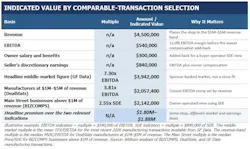
Let’s consider ABC Company, a contract machine shop generating $4.5 million of revenue. After paying its owner-operator $300,000 in salary and bonuses, ABC Company reports EBITDA of $540,000 and seller’s discretionary earnings (SDE) of $840,000. The owner reads the headline 7.3x EBITDA multiple and thinks ABC Company is worth $3.9 million. He’s happy.
However, if we deconstruct that 7.3x multiple, we can see it includes middle-market, private-equity-backed transactions that aren’t representative of a small owner-operated shop. Similarly sized companies in the DealStats database ($1 to $5 million in revenue) had an average EBITDA multiple of 3.81x. When applied to ABC Company, it produces a value of approximately $2.1 million.
Additionally, the Bizcomps database had an average SDE multiple of 2.55x for businesses above $1 million of revenue. When applied to ABC Company, this multiple produced a similar value indication of approximately $2.1 million.
That’s why parsing the underlying data instead of blindly applying multiples can produce more meaningful and realistic results (see table below).
Does Size Really Matter?
Generally speaking, it does, but not for the reason most owners assume.
My colleagues and I looked at 4,661 manufacturing transactions across three major deal databases: Bizcomps, DealStats, and GF Data. Each database tells a different story because each one is tracking a different kind of seller.
Bizcomps covers Main Street, owner-operated shops and shows a median multiple of 2.15x seller's discretionary earnings (SDE), which are earnings measured before the owner's paycheck comes out. DealStats covers the lower-middle market and shows a median 4.80x EBITDA, which is measured after owner compensation. GF Data covers private-equity-backed deals and shows a median 6.48x EBITDA.
Part of that spread is just accounting: SDE and EBITDA aren't the same yardstick, so comparing them directly overstates the gap. But even after you account for those differences, size still buys a real premium. Inside the DealStats data alone, the median multiple climbs from 3.76x EBITDA for companies under $1 million in revenue to 12.49x for companies over $100 million.
Why? Because bigger companies tend to have the things buyers actually pay up for — diversified customers, clean financials, a management bench that isn't just the owner, and easier access to capital. Size doesn't buy the multiple directly. It buys the traits that do.
Beauty Is in the Eye of the Buyer
Who's writing the check matters almost as much as what you're selling.
Acquisitions by public companies carried a median 11.85x EBITDA. Private acquirers paid a median 4.20x; i.e., less than half. Strategic buyers may justify paying a premium because combining the businesses can reduce costs, increase revenue and provide access to cheaper financing. Financial buyers are running the numbers like a bank would. They’re focused on expected returns, debt service and what it would take to run the place themselves. A wider, more competitive buyer pool moves your price before anyone even looks at your P&L.
Cash Is Still King
Here's the part that gets skipped in every headline-multiple conversation: how you actually get paid.
Only 37% of the nearly 5,000 deals we studied closed all cash. The median seller took home 78% in cash at closing, with the rest riding on earnouts, seller notes or other deferred terms such as money that comes with performance risk and collection risk attached. Sellers with under $1 million in revenue got a median 81% cash down, worth about 1.57x SDE. Sellers above $5 million got roughly the same percentage, but it worked out to 2.76x SDE in actual cash.
Two offers can carry the identical multiple and be worth very different amounts once you price in what's deferred and how collectible that money really is. The number to focus on isn't the one on the letter of intent. It's the one that clears your bank account.
So, What Should You Actually Do with This?
Go back to the machine shop example. Its owner-operator earns $300,000; the business reports $540,000 EBITDA and $840,000 SDE. Apply the DealStats average for similarly sized companies (3.81x EBITDA) instead of the headline 7.3x, and the value comes out to around $2.1 million. Apply the bizcomps average SDE multiple for shops over $1 million in revenue (2.55x), and you land in almost exactly the same place. Not $3.9 million. Roughly half of that.
If you're weighing a sale, a transition to the next generation, or a buy-sell agreement, three tactics will get you closer to a real number than any headline multiple will:
- Match the database to your buyer pool. A private-equity-heavy dataset doesn't describe an owner-operated shop, and vice versa. Find the comparable set that actually looks like your likely buyer.
- Match the earnings measure to your business. If your compensation structure is unusual, SDE will tell you more than EBITDA or vice versa. Using the wrong one silently changes your answer.
- Price the deal structure, not just the multiple. Ask what percentage is cash at close, and treat everything else as a discounted, risk-adjusted promise, not face value.
A multiple isn't a number you look up. It's a number you must take apart before it means anything.
Whether the owner’s intent is an exit, a transfer to the next generation through estate planning, or a buy-sell agreement, a realistic valuation is essential for manufacturing companies on the market. A headline multiple is not enough information. The selected transaction market and earnings measure must fit the business and the buyers most likely to compete for it. The stated price must be evaluated against the cash (i.e., the “walkaway money”) the seller can expect to realize at closing.
About the Author
Anthony Venette
Manager, Corporate Value Consulting, Withum
Anthony Venette, CPA/ABV, MBA, leads Withum's tax valuation services practice. He works with privately held businesses, their owners, and their advisors on business valuation, ownership transitions, mergers and acquisitions, and gift and estate tax planning. Forbes named him to its 2026 America's Best-in-State CPAs list and its 2025 America's Top CPAs for Valuations list. He works out of Rochester, New York.
Related
 Accounting