Free Enterprise: Another 250th Birthday Worth Celebrating
Key Highlights
- Published in March 1776, Adam Smith's "The Wealth of Nations" was the foundation for the modern free enterprise system.
- Rigid, agrarian feudalism had kept the vast majority of the population barely surviving and living in poverty, while a few families controlled all the wealth.
- Smith argued for easing government and private property restrictions to encourage innovation and open competition.
- The vast majority of significant innovations of the past millennium came after the shift to capitalism.
This summer, the United States proudly commemorated the 250th anniversary not just of this nation, but of one of history’s most profound philosophical ideas: that individuals have a natural right to life, liberty, and the pursuit of happiness. This, in turn, serves as the foundation for one of the greatest political movements in history: the establishment of the world’s first democratic republic.
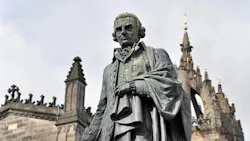
But as important as that commemoration is, we missed celebrating the semiquincentennial of another revolutionary concept. In March 1776, the Scottish economist Adam Smith published his remarkable multi-volume thesis “The Wealth of Nations,” which provided the foundation for the modern free enterprise system.
How important was this idea? Along with the concept of political freedom, economic freedom has served as the seminal factor in the growth and success of the United States, luring millions of immigrants to our shores and creating what became the most dynamic, prosperous economy ever to exist.
Toppling Feudalism
Why did Smith’s musings have such a significant impact on Western society?
To understand this, you need only look at the state of humanity prior to the advent of capitalism. For thousands upon thousands of years, human civilization was mired in poverty, with each subsequent generation seeing little if any increase in living standards. The vast majority of humans barely survived at a subsistence level, constantly in fear not only of disease but of malnutrition and even starvation.
The centuries of rigid, agrarian feudalism underlying trade and commerce ensured that most people had access to a bare minimum of material needs throughout their relatively short lives. A small fragment of the population—whose wealth came not through entrepreneurism but through family pedigree—controlled most of the means of production (including land, tangible assets, and laborers), which for everyone else meant little opportunity for upward social mobility. Authoritarian political leaders maintained this system by restricting the flow of wealth through state intervention, particularly in the form of mercantile economic policies that rewarded the rich, and of heavy tariffs and trade barriers that punished the poor.
Adam Smith contended that government restrictions on the flow of goods and services and limits on private property rights kept human society locked in poverty. Instead, he argued that reducing commercial restrictions and allowing individuals to operate in their own self-interest would in turn create broader social and economic benefits than governments dictating prices and resource allocation. The key was to encourage private ownership of property and open competition, which keeps quality high and prices fair.
'The Invisible Hand'
Smith coined this “the invisible hand”: consumers acting in their own interest, with their own resources, making isolated market decisions and deciding on their own vocations without any central coordination. The result, over time, was a slow but steady increase in standards of living.
For example, as one notable economist has calculated, as recently as 1820, more than 80% of the global population and 45% of Americans lived in poverty. Those numbers have fallen to roughly 20% and 10%, respectively. Life expectancy around the world has climbed from 35 years to almost 75 years since 1800. Child mortality has dropped from roughly 40% to under 4% due to sanitation, refrigeration and advances in medicine. And global wealth per person has increased tenfold.
All of this is directly related to the emergence of free-market forces guiding supply and demand in newly emerging capitalist economic systems. As Smith maintained, eliminating government controls—whether in the form of state ownership, restrictive regulations, or favoring only a few commercial ventures—ultimately incentivized individuals to innovate and led to greater productivity and wealth.
Setting the Stage for Innovation
Another example of the impact of Adam Smith’s work: Before the rise of capitalism, watershed inventions and innovations arose only sporadically throughout history—such as domesticating the horse (5000 BCE), the creation of steel (2000 BCE), the introduction of paper currency (900 CE), the invention of the printing press (1400 CE). After the first Industrial Revolution, which coincided (far from coincidentally) with the publication of “The Wealth of Nations,” such seminal advances appeared more regularly. In the U.S. this was encouraged, in keeping with Smith’s thesis, by the U.S. Congress’ enactment in 1790 of the first patent statute, incentivizing inventors by recognizing intellectual property rights, a key legal framework that led to a tidal wave of new ideas.
Indeed, in 2024 when The Ohio State University ranked the greatest 10 inventions of the past millennium, only one—the printing press—preceded the rise of free enterprise. The rest—nuclear reactors, genetic modification, vaccinations, harnessing microwaves, computers, electricity, the internal combustion engine, fractional distillation of crude oil and antibiotics—were a direct consequence of an economic freedom our ancestors prior to the late 18th century never experienced. (And consider the inventions that didn’t make this list, from the steam engine to automobiles and airplanes to the telephone and the internet.)
Nobel Prize winner Milton Friedman once pronounced, “So that the record of history is absolutely crystal clear … there is no alternative way, so far discovered, of improving the lot of the ordinary people that can hold a candle to the productive activities that are unleashed by a free enterprise system.” Let’s commemorate this semiquincentennial of this country – and the birth of capitalism.
About the Author
 Stephen Gold
Stephen Gold
President and Chief Executive Officer, Manufacturers Alliance
Stephen Gold is president and CEO of Manufacturers Alliance. Previously, Gold served as senior vice president of operations for the National Electrical Manufacturers Association (NEMA) where he provided management oversight of the trade association’s 50 business units, member recruitment and retention, international operations, business development, and meeting planning. In addition, he was the staff lead for the Board-level Section Affairs Committee and Strategic Initiatives Committee.
Gold has an extensive background in business-related organizations and has represented U.S. manufacturers for much of his career. Prior to his work at NEMA, Gold spent five years at the National Association of Manufacturers (NAM), serving as vice president of allied associations and executive director of the Council of Manufacturing Associations. During his tenure he helped launch NAM’s Campaign for the Future of U.S. Manufacturing and served as executive director of the Coalition for the Future of U.S. Manufacturing.
Before joining NAM, Gold practiced law in Washington, D.C., at the former firm of Collier Shannon Scott, where he specialized in regulatory law, working in the consumer product safety practice group and on energy and environmental issues in the government relations practice group.
Gold has also served as associate director/communications director at the Tax Foundation in Washington and as director of public policy at Citizens for a Sound Economy, a free-market advocacy group. He began his career in Washington as a lobbyist for the Grocery Manufacturers of America and in the 1980s served in the communications department of Chief Justice Warren Burger’s Commission on the Bicentennial of the U.S. Constitution.
Gold holds a Juris Doctor (cum laude) from George Mason University School of Law, a master of arts degree in history from George Washington University, and a bachelor of science degree (magna cum laude) in history from Arizona State University. He is a Certified Association Executive (CAE).