Build Where You Sell: Sizing Up China’s Automotive Strategy for North America (Part I: Mexico)
Key Highlights
- Mexico and Canada are taking a more nuanced approach than the United States when it comes to Chinese investment, reflecting the reality of recent plant closures and elimination of shifts.
- The Mexican government took note of high sales from brands like BYD and Chery and raised vehicle tariffs to 50 percent on China-sourced imports, from 20 percent in 2025.
- In the baseline scenario, the tariff increase would cause a sales decline in Chinese-sourced imports through 2030, leaving room for production increases at other OEMs in Mexico.
- A more likely strategic move by China would include building assembly plants in Mexico and moving production there.
- This would give the Mexican government additional leverage during upcoming USMCA negotiations.

This article is the first in a three-part series reviewing the potential moves Chinese manufacturers could make to avoid duties in North America. The first installment covers Mexico. Next week, I’ll review Canada, followed by a review of the United States.
Chinese Auto Exports and the USMCA: Read the Full Series
Part I: Sizing Up China’s Automotive Strategy in Mexico
Part II: Big Changes in Canada's Automotive Strategy With China
Part III: China's New Production Strategy Will Put a Dent in US Exports
There also has been a fair amount of speculation about Chinese assembly investment in the region. While no concrete plans have been announced, at least four Chinese manufacturers have been identified as “exploring” manufacturing locations. GAC is the only one that has confirmed its intent, with the location still unannounced.
The reports have created an impression that the Chinese vehicle incursion is imminent. The impression has led to pleas for stricter U.S.-made regulations in a future USMCA agreement, and national-security clauses that keep all Chinese vehicles out of the region. Some U.S. politicians would view this as “making American great again.” Others in Canada and Mexico may differ.
While the exclusion argument is valid for all three USMCA members, the existing trade relationship among the three countries has set Mexico and Canada on a different path when it comes to Chinese investment. The United States will maintain Chinese product and technology exclusions. Canada and Mexico will take a more nuanced approach, reflecting the reality of recent plant closures and elimination of shifts. (Canada and Mexico need jobs, too.)
What follows here outlines a realistic Chinese automotive investment strategy for Mexico, beginning with a baseline that only considers Chinese vehicle imports through 2032. Having a baseline allows a comparison to any local investment advantages. Likewise, a local manufacturing strategy may take more time to develop than reflected in this study.
Chinese Vehicle Manufacturers in Mexico
Baseline Observation
Chinese sales growth has been spectacular in Mexico. Thirteen Chinese vehicle manufacturers are now selling in Mexico, generating 275,000 in sales in 2025. The Detroit 3 automakers and Tesla sell an additional 158,000 units imported from China.
In total, China-sourced vehicles captured 26% of the Mexican light vehicle market in 2025. Not surprising given the multitude of entries, only one China-sourced vehicle sells over 25,000 units—Chevrolet’s Aveo. Other models sell quite a bit less. Yet, the total sales level finally rattled the Mexican government into action.
In a move to protect their automotive industry, the Mexican government raised vehicle tariffs to 50% on China-sourced imports, from 20% in 2025. A tariff level that high will influence demand. Thus, a 14% sales decline is expected this year. Moving forward, sales will continue to decline each year to a maximum of 185,000 units by 2030.
This assumes that vehicle pricing is adjusted in proportion to the tariff increase, and the tariffs remain in place. To date, vehicle prices have only increased modestly, if at all.
Implications: This baseline would be great news for the Mexican government. Tariff revenue would increase modestly. Light vehicle production and employment would increase in Mexico, along with a slight production increase in the United States and Canada.
Existing vehicle assemblers in Mexico would likely favor this scenario as well. North American production would increase in all three markets by a total of 175,000 vehicles per year. Ironically, Mexico could help President Trump deliver on his promise of more U.S. light vehicle production.
Other developments:
A production increase for vehicles made in Mexico, like Nissan’s Versa and Kicks, Kia’s K3 and Mazda CX-30. To a lesser extent, Ford Bronco Sport and Maverick would get a boost; Equinox, too. Toyota’s Tacoma and Nissan’s Frontier/NP300 would certainly benefit.
Small increases in United States and Canada production to benefit from the 50% tariffs on Chinese: Toyota’s RAV4 and Honda’s CR-V would see the largest increase in production due to increased exports to Mexico. Jeep Wrangler and Compass would also benefit.
Brazilian production would increase due to re-sourcing of models like the Chevrolet S-10. Brazilian exports of Chevrolet Onix and Tracker would get a boost, as would Ram 700.
A shakeout of Chinese importers and low-priced trim levels would ensue. BYD and Chery would increase imports from Brazil.
More Likely Scenario: Chinese Brands Maintain Share in Mexico. GM Re-Sources Away from China.
Will there be a natural commercial alliance between China and Mexico that goes beyond imports? Yes, it’s simple. Chinese brands will want to hold on to existing market share, and the Mexican government wants more jobs. Further, it is tough to imagine that Chinese importers can absorb a 20- to 30-point decrease in margin. That is why they are shopping around for Mexican assembly sites.
What makes Mexico unique? Currently, over 90% of Chinese sales in Mexico are imported. A 50% import tariff would be expected to result in serious import substitution. That situation does not exist in the United States or Canada. Thus, a more likely strategic move by China would contain a high proportion of products made In Mexico, avoiding the high tariffs. GM would follow the same approach.
In this localization scenario, Chinese manufacturers’ 2030 sales volume is 200,000 units higher than the baseline. By 2032, their share of the market would recover to just above 2025 levels, generating 472,000 sales. Obviously, achieving this volume will require increased investment for OEMs and suppliers. (Without localization, the duties on parts would still be 50%.)
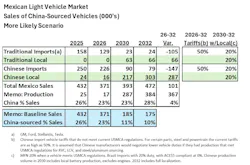
Given the manufacturing assumptions shown in the next chart below, each Chinese manufacturer will supplement their local production with imports from Brazil and limited imports from China. They will also use this capacity to increase exports to Central and South America. The chances the Mexican government will force some type of joint venture, either with the government or with a manufacturer, is quite high.
Scenario assumption: Chinese exports to the United States will be banned or have a duty of more than 100%.
GM will add three models to Ramos Arizpe by 2028, with allocated capacity of 75,000. Brazilian exports supplement deleted Chinese models.
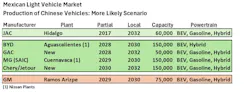
Implications: The Mexican government would benefit beyond what the baseline scenario provides. Existing assemblers, like Toyota, would lose the production benefits gained in the baseline.
- Two idled plants would be restarted (Aguascalientes JV with Mercedes, Cuernavaca) The increased production would add jobs and lessen Mexico’s dependence on exports to the United States.
- Two new greenfield plants would add employment.
- The government would have leverage during upcoming USMCA negotiations: fewer Chinese plants for lower tariffs on existing Mexican exports.
- Customers would have access to lower-priced vehicles when compared to the baseline because of lower tariffs.
The localization strategy would provide Chinese manufacturers with more experience in the North American region. It would also increase their supplier base. Overall, it would be an additional play intended to help them dominate the vehicle markets of Central and South America.
About the Author
 Warren Browne
Warren Browne
President, RFQ Insights
Warren Browne is adjunct professor of economics and trade at Lawrence Technological University in Southfield, Michigan. He is a retired General Motors executive with global experience, working in six countries over a 40-year career with the automaker.