PPG Revs Auto Strategy With Ohio Plant Expansion
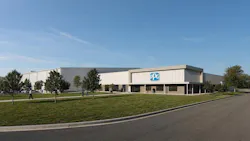

PPG’s Delaware, Ohio, plant dates to 1965, a much different era for industrial coatings production with huge batch production and the use of solvents that today are considered highly toxic. The manufacturing facility has seen incremental upgrades over the years, but now the paint and coatings company plans to add 100,000 square feet and 100 jobs to the existing 400,000-square-foot, 450-person worksite. Construction is expected to be complete by early 2028.
Rising demand in sustainable coatings for electric vehicles, among other applications—and a need to upgrade older plants with digital technology for faster, more targeted production—led to the decision. The new addition will increase the plant’s production of waterborne coatings and have more advanced infrastructure for water reuse and recovery, solvent recovery and emissions control. Lighter, more insulating and heat-resistant waterborne coatings help automakers meet sustainability targets and are essential to fire prevention in electric-battery systems.
In advance of the groundbreaking of the new site on August 6, IndustryWeek spoke with Alisha Bellezza, who has led PPG’s Global Automotive & Packaging Coatings business as senior vice president since July 2023.
Bellezza has moved through the manufacturing ranks at a steady clip. She began her career in the early 2000s as a financial analyst, then took on increasing responsibility in corporate strategy and investor relations at agricultural science company FMC. Prior to PPG, she spent eight years at Chemours, moving up from treasurer to vice president of Fluorochemicals and then president of Thermal and Specialized Solutions, a $1.7 billion global business.
We spoke with Bellezza about the new plant expansion and how she manages a global team with vastly different priorities depending on where their markets are located.
IndustryWeek: First, a career question. How did you make the leap from a finance role to leading a division at PPG?
Alisha Bellezza: One of the things that served me really well is having a pretty strong intellectual curiosity, asking a lot of questions, and making myself available for different and special projects, and really trying to stretch my participation across different disciplines.
I've had the wonderful opportunity to participate in many different end markets. Through finance, you can get a really interesting bird's-eye view of different industries, different business structures, different go-to-market strategies—and you get to interact with a lot of different people and functions outside the company. It really broadens perspective.
At a couple of key points in my career, I was blessed to have some really strong mentors and sponsors—and I think of those as two different things. I was definitely using mentors as sounding boards, to give me the right direction or course-correct when I needed it. And then I was really fortunate to have some strong sponsors who had more confidence in me to go beyond what I thought I was headed toward than I did at the various times in my career, and had me stretch and feel comfortable stretching beyond what I was currently very comfortable or a subject-matter expert in.
They put me in places and in roles where I was no longer the subject-matter expert, and I had to figure out what or how to operate and how to create value or how to help support my team and those around me. Those experiences were incredibly valuable for me to then make that leap from being a functional leader into a more holistic business leader.
I have a lot of respect for finance, but it’s a lot of fun making the news versus just reporting the news sometimes. So yeah, I'm very lucky. I'm very appreciative of the opportunities I've been given along the way.
How would you describe the culture in the PPG division you lead?
The automotive industry has gone through so many significant cycles in transformation. We're certainly watching a very dramatic transformation unfolding in front of us with electric vehicles. While not as pronounced here in the U.S., it is taking off in other markets around the world. We feel and see that to be in the automotive business, I do believe it takes resilience and grit to be successful, and weather through some of those changes.
This team is very close-knit, and it is very much defined by how we support our customers. We know that they are looking to be successful in this dynamic marketplace. That is critical in the automotive business—demonstrating to customers that we are here to support their needs, be it growth, productivity, sustainability.
How does the global nature of your role work from a management perspective, when you’re in meetings and people have priorities that may be very different?
In some parts of the world, people are much more reserved and deferential to our structure. My personal opinion as a leader is that we benefit immensely from diversity of opinion. And so, with recognition of that, I actively try to engage those folks into the conversation, and I encourage my team members to elicit each other's opinions.
I have a leadership mantra, which is “truth before harmony,” and I really try to encourage an open and transparent environment for all of the team because I believe that it's with transparency and openness that we can address challenges more holistically and faster.
Competing priorities are ever-present, right? And I think that it is about constant reprioritization and acknowledging what might be different in different parts of the world, whether it's market science or political dynamics that are shaping current business environment. We then need to modify how we approach each of those aspects around the world.
How my business leader Thomas Li in Asia is addressing his customer base can be quite different than how my business leader Andrew Carroll here in the Americas might be addressing some of our customers. So communication and connection and collaboration become incredibly important and critical to success for managing through changing priorities. But I think even more importantly, managing and understanding what our customers' priorities are—because that's what allows us to be adaptive and responsive to them, which is ultimately their success.
Is there a difference in dynamic working with EV manufacturers vs. the big OEMs?
We see some differences sometimes, particularly with an EV manufacturer versus a traditional manufacturer. Many times, these lines are now starting to blur. The traditional manufacturers see what’s coming and know they need to participate in a meaningful way.
I would say there are differences in speed to adopt technology, differences in speed for the development cycle—and the trick for us is being able to respond to those differences and meet our customers where they need us.
You asked earlier about the culture of the automotive team at PPG. I guess maybe one thing I might add to that is adaptability and agility. That is incredibly critical at this point with this market to be able to flex where and how we're focused and understand and translate customer needs into what technologies or services we should provide for them. And service becomes a really important aspect. The paint shop is not a simple set of processes to manage, and it's where we have a tremendously talented team of frontline individuals who actually are PPG employees that sit at our customers' sites that can help deliver value to them every day.
Is speed to market faster with some of the EV manufacturers?
It can be. I would say the most notable difference that I have witnessed is probably from Asian producers versus some of the more Western producers. The speed to market and the proliferation of models or colors and concepts in Asia is very pronounced relative to the U.S. as an example.
How important is sustainability to your customers, and is it becoming more important?
You know, given the nature of automotive and its relationship to consumers, sustainability is table stakes now, and it is magnified in other parts of the world.
How are you using technology to help those customers meet sustainability goals?
I'll do it in two dimensions. One is certainly our traditional chemistries. We recognize that the paint shop is one of the most energy-intensive aspects of car assembly process. So, we're working now to reduce that energy consumption, which has two benefits.
If we can reduce the temperature of the curing ovens, it reduces [customers’] energy consumption, lowering their costs and also then lowering their CO2 footprint.
The other thing that we're working on is our digital solutions. This is a whole ecosystem approach that we are taking to support our customers in meeting productivity, efficiency, throughput and sustainability.
What we think about this is starting from design and trying to help them reduce the time of design development. It could be anything from the geometry to the aesthetics of the vehicle—giving them digital tools that can help them with color options or the appearance of or effectiveness of functionality of a coating, all the way through creating tools that help optimize the application at the end of the line of a paint shop.
It's going to help our customers get faster, which is critical with the changing market dynamics of all of the global players in the market.
Are there any challenges around raw materials that you’re dealing with?
Certainly the conflict in the Middle East has put strain across the various supply chains. Our customers are facing those challenges. The great thing about PPG is our footprint and our ability to have multiple areas to access materials. So while it's not easy, we've been doing it very effectively. And I give credit to our procurement teams and our operations teams around the world for navigating this. And so far, no major supply disruptions.
Have you had to raise prices because of raw materials issues?
Certainly. I think we are certainly not immune to the effects of the inflation that's been borne around the world, and that's something that we've been very open with our customers in sharing with them what we're seeing with the raw material increases and partnering with them in order to manage through this cycle.
What are some industry-defining trends that you're on top of right now?
What’s really exciting for us is how OEMs are starting to consider technology very early on in the process and thinking about using our products to be a source of differentiation for them. So that surface treatment, the aesthetics, the functionality of coatings. I mean, EVs necessitate different functionality from our products, and being able to integrate with them early on in that process is something that we think we can bring pretty exciting stuff in coatings technology.
About the Author
 Laura Putre
Laura Putre
Senior Editor, IndustryWeek
As senior editor, Laura Putre works with IndustryWeek's editorial contributors and reports on leadership and the automotive industry as they relate to manufacturing. She joined IndustryWeek in 2015 as a staff writer covering workforce issues.
Prior to IndustryWeek, Laura reported on the healthcare industry and covered local news. She was the editor of the Chicago Journal and a staff writer for Cleveland Scene. Her national bylines include The Guardian, Slate, Pacific-Standard and The Root.
Laura was a National Press Foundation fellow in 2022.
Got a story idea? Reach out to Laura at [email protected]