Humans in the Lead, Not the Loop: the Future of Manufacturing R&D
In 2025, manufacturing R&D leaders were dealing with crisis after crisis: the accelerating adoption of AI, geopolitical instability, supply chain disruption, tariffs, regulatory changes, workforce shortages and a host of other industry-specific issues.
In 2026, they’re still in crisis mode, but as we’ve seen time and again, they are evolving to meet the challenge. It is becoming increasingly clear that the relative predictability of the pre-pandemic era is a thing of the past and companies will need to rethink their existing processes and structures to succeed in our new era.
If you asked these leaders the top skill they should be developing in their teams, the assumption is that their answer would be how to work with AI. It’s more nuanced than that.
At the Innovation Research Interchange (a division of the National Association of Manufacturers) spring gathering of manufacturing R&D leaders in both 2025 and 2026, attendees were asked what questions they would need to answer to be better prepared for the future.
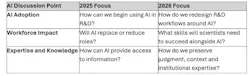
From one year to the next, we saw a shift from reactivity—responding to crisis after crisis—to proactivity: building the capabilities to weather whatever crisis is on the horizon.
Here are some examples of that shift around AI specifically:
A Vision of the Manufacturing R&D Organization of the Future
Planning to be proactive is all well and good, but you need to figure out what you're being proactive toward. What is a good example of a successful R&D organization in the not-so- distant future, one that keeps innovating despite disruption?
To answer that question, IRI gathered a working group of senior leaders to explore what sort of organization will be needed to support innovation in an uncertain medium-term future (early 2030s). From there, the group then drilled down into the skills and capabilities each R&D team would need to in order to bring that organization to life.
The team identified the future R&D function of a global organization as AI-enabled, globally distributed, platform-driven and ecosystem-integrated. The organization will operate as a dynamic network rather than fixed structure while combining internal expertise with external partnerships to accelerate learning and value creation. Speed, adaptability and the ability to orchestrate across boundaries will define competitive advantage.
Quilting Our Way to the Future
Alexa Dembek, former chief technology and sustainability officer at Dupont, has likened teams to quilts. Not every individual component is supposed to be the same. When individuals come together with the different things that they bring to the table, they create something both beautiful and functional.
To determine what components are needed to make this vision of a future R&D organization function in reality, the working group mapped the attributes above to the skills and capabilities needed to actually achieve them.
In addition to deep technical knowledge, the top five essential skills and capabilities R&D teams will need are:
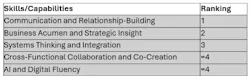
While certainly AI and digital fluency are included in the list, they are not at the top. R&D leaders see the future not as one where humans are in the loop with AI, but where humans are in the lead, understanding where potential projects fit within their organizations’ strategic plans, working across different teams to make ideas a reality and selling ideas internally to make everything happen.
To bring these theoretical future teams to life, the working group (working with Microsoft Copilot) created three sample R&D teams, one focusing on incremental innovation, one on adjacencies and one on transformational innovation. Each team had an AI-agent team member.
In each team, the AI team member did what AI does best: taking large amounts of data and converting it into manageable data points that can feed into human decision-making. For example, the transformational innovation team’s AI agent identified weak signals and built future scenarios with opportunity spaces identified. This gave human team members the ability to see more viable opportunities than before and created more opportunities for feasible projects to explore, with risks and capabilities already known to a higher degree.
This was the first phase of IRI’s study of future R&D skills and capabilities. The aim here was to diagnose the condition. The next phase will be the treatment: How do we develop those skills and capabilities?
In the meantime, leaders should start laying the groundwork with their teams:
1. Go back to basics. Don’t underestimate the importance of team-building activities. Get people talking to one another and connecting.
2. Reinforce the connection. Help build business acumen by explaining and reiterating how and why each project relates back to the organization’s strategic goals.
3. Encourage working cross-functionally. Deliberately put different teams together to work on a shared challenge and be explicit that you are doing so to get them working better together. Don’t let the teamwork get lost in the drive to solve the challenge.
Both will contribute to the R&D organization’s quilt, but in very different ways. The ability to build those relationships, understand who needs to be working together, and get everyone rowing in the same direction are uniquely human skills. Companies that are able to leverage these skills while using AI to speed up their processes will be the ones to thrive in the next era.
To learn more, check out IRI’s Future R&D Capabilities Phase I Study: Top Skills Needed for Successful R&D Teams
About the Author
Lee Green
AVP, Research and Strategy, Innovation Research Interchange
Lee Green serves as assistant vice president of content and strategy at the Innovation Research Interchange, a division of the National Association of Manufacturers. With over 15 years of expertise, she specializes in addressing industry needs in innovation, sustainability, and digitalization, including AI. Lee is passionate about foresighting trends to anticipate future developments and prepare industry for the unknown. She holds an M.A. in international studies from the University of Reading (U.K.) and a B.A. in political science and international relations from the University of Toledo. Lee resides in northern Virginia with her husband, twins and dog.