Clorox CEO Makes Hard Choice; What's Tinier Than a Nano? So That Happened
Editor’s note: Welcome to So That Happened, our editors’ takes on things going on in the manufacturing world that deserve some extra attention. This appears regularly in the Members Only section of the site.
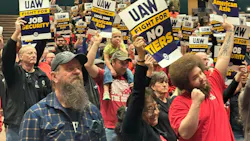
Dauch/American Axle Workers Shift Into Strike
Nearly 1,000 UAW Local 2093 workers at Dauch Corp. (formerly American Axle) began a strike on June 1 at the company’s Three Rivers, Michigan, plant amid a dispute over wages. Dauch is a Tier 1 parts supplier to General Motors, with its products used in some of the automaker’s pickup trucks. Last month, the members voted 98% in favor of authorizing strike action.
Worker wages were slashed during the Great Recession in 2008 from as much as $29 an hour to $14.50 an hour to protect the facility from closure, according to the UAW. Eighteen years later, according to the union, pay has still not recovered, topping out at $22 an hour after a five-year progression, and workers are struggling to afford necessities.
“This company has made $8.4 billion in the last decade, while some of their workers are sleeping in their cars,” said UAW President Shawn Fain during a livestream update on Sunday. “Auto parts workers everywhere are fighting for their fair share. They’re not asking to be millionaires, they’re asking for dignity.”
Members have also filed federal unfair labor practice charges against Dauch. The UAW alleges company management in April called local police on off-duty employees distributing union literature and threatened termination and trespassing charges.
In an emailed statement to CNBC, Dauch described the strike as “disappointing” but said it is committed to good-faith negotiations and hopes to reach a fair agreement promptly.
-Anna Smith
Nano Dimension Prepares to Get Smaller Still
Remember the Great Additive Manufacturing M&A Standoff of 2023?
First, Nano Dimension wanted to take over Stratasys in a deal that valued the latter at about $1.3 billion. Then Stratasys sought to buy Desktop Metal for $1.8 billion. The next week, 3D Systems offered $1.2 billion for Stratasys. Good times.
The dust has settled quite a bit since, and the sector’s leaders have done a better job finding profitable uses for their products. And the dollar amounts being thrown around by the big publicly traded players have taken a massive haircut.
So it barely registered late last month when Stratasys executives said they had inked a deal to pay $42.5 million for Markforged, a subsidiary of Nano that last year booked $70 million in sales and specializes in so-called continuous carbon fiber technology. Adding Markforged would let Stratasys grow its presence in the booming aerospace and defense industry, as well as the automotive and food/beverage sectors.
Word of Nano’s planned divestiture came less than two months after CEO David Stehlin announced he had signed a deal worth up to $12.5 million to sell the company’s additively manufactured electronics product line and the discontinued Fabrica line to medical device company Inspira Technologies.
Stehlin and team have been looking to cut costs as part of a broader strategic review—in Wall Street parlance, that typically means “We want to sell”—after Nano was given a court order to complete the acquisition of Desktop Metal for $179 million. Nano did that in April of last year and pretty quickly put Desktop Metal through a bankruptcy court liquidation that generated less than $20 million.
— Geert De Lombaerde
Health Takes Priority as Clorox CEO Announces Plan to Exit
The press announcement by the Clorox Co. last week that Chairman and CEO Linda Rendle would be leaving her leadership position after six years followed a fairly typical template: The company would initiate a CEO search process at the request of Rendle, who said health reasons prompted her decision. The departure is not immediate, the release said, with Rendle committing to remain chair and CEO until a successor is appointed and then serve in an advisory role for some period of time afterwards.
In an unusual move, however, Rendle shared a personal note about her decision—and her health—on the company's website.
"I am grateful that I am cancer-free after having been diagnosed with early-stage breast cancer. But, while I am doing well, the side effects of my ongoing treatment to prevent recurrence have prompted me to think carefully about how I care for my health and family," she wrote.
"The decision to step away from the company and role that I love so much was incredibly difficult. But as I worked through it, I kept coming back to advice I give my team all the time: Control what you can, have the courage to make the hard choices, and take care of yourself so you can take care of others. Those words have guided me in business, and now they are guiding me personally."
Rendle, who has held numerous roles within Clorox over the past 20 years, was named CEO in September 2020. In early 2024, she added board chair to her responsibilities.
In her message, Rendle also made it clear that for now, it’s business as usual.
“ … while I’m making a choice for the long term, nothing changes in the short term. I remain fully committed to Clorox and to leading the company through this transition. Until a new leader is in place, my focus remains exactly where it has always been – on advancing our strategy, improving execution, and supporting our team.”
—Jill Jusko
Auto Supplier Survey: The Ongoing Supply Chain Crisis … Lifts Everyone’s Spirits?
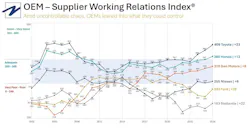
For 26 years, the North American Automotive OEM-Supplier Working Relations Index has tracked how well six automakers—General Motors, Ford, Stellantis, Toyota, Honda and Nissan—work with their suppliers. This year is a milestone of sorts: the first time that relationship scores improved across the board from the year prior.
Angela Johnson, a former GM strategist who is now principal at Plante Moran, attributes the angst reduction to a roll-up-your-sleeves, “we’re all in this together” attitude after years of supply-chain crisis—beginning in 2019 with labor shutdowns, then COVID and cascading geopolitical disruptions.
“I'm going to call it ‘permacrisis fatigue,’ and what I mean by that is everybody out there might not be happy, but you're starting to see a recognition that everybody's out there trying to help each other deal with the crisis, says Johnson, who led the WRI survey research. “I think that helped put an undercurrent of a positive spin on it.
Relatedly, return-to-office mandates helped suppliers access OEM buyers more quickly to problem-solve, says Johnson. OEMs “can't quite control EVs, and they can't quite control tariffs, and how a cost recovery goes, but they can control, are we taking the meeting, are we listening, are we coming to the table, and they all stepped up in that field.”
Another bright spot: Post-COVID, survey respondents called out early-career OEM buyers for being disengaged and unresponsive, but “I did not see that this year,” added Johnson. “What I was very pleased to see this year was a lot of times when they talk to new buyers, ‘they might not know the answer, but they’re really willing to find out. They’re eager to learn; they want to know about my business.”
OEM rankings in the 2026 survey remained the same as in 2025, with Toyota first in supplier relations, then Honda (2), GM (3), Nissan (4), Ford (5) and Stellantis (6).
—Laura Putre
About the Author
 Jill Jusko
Jill Jusko
Bio: Jill Jusko is executive editor for IndustryWeek. She has been writing about manufacturing operations leadership for more than 20 years. Her coverage spotlights companies that are in pursuit of world-class results in quality, productivity, cost and other benchmarks by implementing the latest continuous improvement and lean/Six-Sigma strategies. Jill also coordinates IndustryWeek’s Best Plants Awards Program, which annually salutes the leading manufacturing facilities in North America.
Have a story idea? Send it to [email protected].
Geert De Lombaerde
Senior Editor
A native of Belgium, Geert De Lombaerde has been in business journalism since the mid-1990s and writes about public companies, markets and economic trends for Endeavor Business Media publications, focusing on IndustryWeek, FleetOwner, Oil & Gas Journal, T&D World and Healthcare Innovation. He also curates the twice-monthly Market Moves Strategy newsletter that showcases Endeavor stories on strategy, leadership and investment and contributes to other Market Moves newsletters.
With a degree in journalism from the University of Missouri, he began his reporting career at the Business Courier in Cincinnati in 1997, initially covering retail and the courts before shifting to banking, insurance and investing. He later was managing editor and editor of the Nashville Business Journal before being named editor of the Nashville Post in early 2008. He led a team that helped grow the Post's online traffic more than fivefold before joining Endeavor in September 2021.
 Laura Putre
Laura Putre
Senior Editor, IndustryWeek
As senior editor, Laura Putre works with IndustryWeek's editorial contributors and reports on leadership and the automotive industry as they relate to manufacturing. She joined IndustryWeek in 2015 as a staff writer covering workforce issues.
Prior to IndustryWeek, Laura reported on the healthcare industry and covered local news. She was the editor of the Chicago Journal and a staff writer for Cleveland Scene. Her national bylines include The Guardian, Slate, Pacific-Standard and The Root.
Laura was a National Press Foundation fellow in 2022.
Got a story idea? Reach out to Laura at [email protected]
 Anna Smith
Anna Smith
Senior Staff Writer
Senior Staff Writer
LinkedIn: https://www.linkedin.com/in/anna-m-smith/
Bio: Anna Smith joined IndustryWeek in 2021. She handles breaking news of interest to the manufacturing industry and the cross-publication newsletter Quick Manufacturing News. Anna was previously an editorial assistant at New Equipment Digest, Material Handling & Logistics and other publications.