The Respect-Driven Motivation Model
Key Highlights
- Respect for People is defined through Five Employee Rights: understanding, involvement, input, success, and humanity, which are essential for building trust and engagement.
- Respect opens the door to motivation, which energizes employees to participate actively in continuous improvement efforts and lean initiatives.
- Aligning workplace practices with the Five Rights activates key motivation drivers—autonomy, achievement, purpose, and camaraderie—leading to higher engagement and better performance.
- Active leadership is necessary to ensure that respect and motivation are consistently fostered, recognizing individual differences and personal goals.
- A cycle of respect and motivation creates a sustainable lean culture, where ongoing improvements enhance company performance and customer value.
One of my previous articles focused on defining the lean principle of “Respect for People.” This principle appears in every legitimate listing of lean principles, but what does it really mean within the context of our challenge of building a lean culture of continuous improvement?
I defined this principle as “Five Employee Rights,” to which every employee, regardless of function or position, should be entitled.
A key message was that not honoring even one of the rights will create a demotivating condition of disrespect, and workforce engagement will not occur. Due to the lost trust, developing a lean culture will be impossible.
But respect is just the first step. It opens the door to engagement, but motivation provides the energy and desire to go through the door.
Since respect and motivation are closely linked, it’s worth reviewing the Five Employee Rights before we address motivation.
1. Right of understanding: “I have a right to explanation to understand why.” What can be more disrespectful to me as a human being than to be told do something—or to make a change, or to be part of something—without being provided the basic justification, the purpose, the why?
2. Right of involvement: “I have a right to be involved in solving problems and making changes directly affecting me.” A message of “just do what you are told” will obviously not engender the employee passion and engagement that we are striving for.
3. Right of input: “I have a right to be listened to. My opinions matter.” Passive involvement is not the point of Right #2. A lean culture requires engaging the hearts and minds of the workforce, not just their arms, hands and legs.
4. Right of success: “I have a right to have the materials, tools, information, training, coaching and support that are necessary to be successful in both the short and long term.” Being set up for failure, whether intentional or not, can only be described as demotivating and demoralizing.
5. Right of humanity: “I have a right to be treated as the intelligent human being that I am who can contribute, learn and grow.” We all have different roles within the organization, and our backgrounds and experience may vary greatly; however, we must create an environment of teamwork, fairness and mutual trust and respect where we see each other as equals.
The Respect-Driven Motivation Model begins with respect and leads to improved company performance.
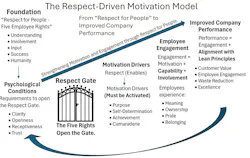
Foundation and Psychological Conditions
When company practices align with the Five Rights, trust is developed and clarity replaces confusion. Openness replaces reluctance and receptiveness replaces closed-mindedness.
Motivation Drivers
Workplace practices and behaviors that support the Five Rights can also activate the drivers of motivation, leading to engagement.
Most modern motivational models converge around the following four motivation drivers and the rights they align with.
Self-determination or autonomy: the desire to have some control over our lives, to gain ownership, to have input.
Aligns with: Rights 2 and 3, involvement and input.
Achievement: the desire to be successful, confident and proud of our work, along with the desire to learn and grow.
Aligns with: Right 4, success.
Purpose: the desire to make a difference, to do something that is impactful, to have meaning or be part of a worthwhile mission.
Aligns with: Right 1, understanding.
Camaraderie: our desire to work with other people. We are social creatures, and the desire to work with our fellow human beings in pursuit of a meaningful objective can be motivating.
Aligns with: Right 5, humanity.
The drivers are not distinct. They can interact. For example, the self-determination driver can positively affect the achievement driver.
Although the Five Rights can activate the motivation drivers, this is not automatic, even if an employee feels respected and passes through the respect gate. What an individual considers respectful and motivational can vary based on several factors, such as personal goals and past experiences. Active leadership is still needed to instill practices and institute standards of behavior.
Employee Engagement and Improved Company Performance
The ownership, pride, meaning, and belonging created by motivation drivers provide the emotional fuel leading to employee engagement. And when workforce engagement is combined with company-wide alignment with lean principles, a culture of continuous improvement is created. This results in improved company performance and greater value for customers.
Continuous Cycle of Respect and Improved Company Performance
The feedback arrow shown in the Respect-Driven Motivation Model depicts a never-ending cycle where:
- The focus on the Five Rights maintains a respectful environment that prevents demotivation from destroying the lean culture.
- Leadership’s ongoing focus on aligning behaviors and practices with the Five Rights to activate motivational drivers creates an engaged workforce that experiences ownership, pride, meaning and belonging.
- When the behaviors of an engaged workforce throughout the organization are aligned with lean principles, the result is continuous improvement and ongoing improved company performance and service to customers.
Building a true lean culture of continuous improvement is a neverending journey, but the Respect-Driven Motivation Model model ties the critical lean issues of respect, demotivation, motivation, engagement and alignment with lean principles. The model shows how the “soft” issues of respect and motivation are, in fact, hard bottom-line business issues.
You start with respect, and it leads to improved company performance, and it continues to repeat in a lean cycle of continuous improvement.
About the Author
David Rizzardo
Associate Director, Maryland World Class Consortia
Dave Rizzardo is the associate director of the Maryland World Class Consortia. His lean experience predates the time when lean became synonymous with business excellence. Dave co-developed the Lean Peer Group service, which helps organizations develop a lean culture. He currently facilitates multiple groups and works directly with organizations in helping them on their lean journeys. His book, Lean - Let's Get It Right! How to Build a Culture of Continuous Improvement, addresses the root causes of why many lean transformations fail to meet expectations, and he provides the information needed to turn things around.