How a Global Automotive Supplier Uses Digital Twins to Solve Production Problems Before They Reach the Factory Floor
Key Highlights
- Brose uses Siemens Plant Simulation to identify production bottlenecks before factory implementation.
- Virtual simulation reduces risk by testing production changes before deployment.
- Engineers optimize material flow, staffing, and layouts with factory simulation.
- Digital twins improve production planning by modeling entire manufacturing systems.
- Simulation enables faster, more confident operational decisions while reducing costly disruptions.
Manufacturing has always been about balancing competing priorities: maximizing throughput, minimizing inventory, adapting to changing demand, and maintaining quality, all while avoiding costly disruptions. As production systems become more automated and interconnected, understanding how a single change affects the rest of the operation has become increasingly difficult.
For many manufacturers, traditional planning tools are no longer enough. Static calculations can estimate cycle times or equipment utilization, but they struggle to capture the variability that defines real production environments. Equipment breaks down unexpectedly. Operators work at different speeds. Material arrives at different times. A change made in one department can create unintended consequences for several downstream processes.
For automotive suppliers operating in high-volume production environments, those uncertainties can make the difference between meeting production targets and creating costly bottlenecks. Brose, a global automotive supplier specializing in seat structures, door systems, and electric drives, has been addressing this challenge by expanding its use of digital twin technology to model production systems before making physical changes on the factory floor. Hear directly from Brose engineers about how they're applying simulation in production planning in this video.
Moving Beyond Static Planning
Like many manufacturers, Brose historically relied on traditional planning calculations to evaluate production performance. While those methods provided a useful starting point, they made it difficult to understand how individual production areas interacted as complete manufacturing systems. Processes such as welding, logistics, and final assembly were often analyzed independently, even though decisions made in one area could significantly affect performance elsewhere.
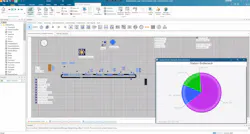
Using Siemens Plant Simulation, Brose built digital models of entire production systems that connected previously isolated planning activities into a single virtual environment. Instead of evaluating equipment or workstations individually, engineers could analyze complete value streams and observe how material, resources, and production constraints interacted over time.
The result wasn't simply better visualization; it was a better understanding of how the system behaved under real operating conditions. For Brose, this has strengthened both day-to-day operational improvements and longer-term production planning.
As Ryan Schoettle, Digitalization Industrial Engineer at Brose, explains:
"With Plant Simulation, we can identify those gaps early on and help address them to really avoid that future cost that we would end up taking on downstream when we actually hit production. And then we can understand those pain points virtually. So if you have the right mindset, the amount of problems that you can solve are really limitless."
Identifying Bottlenecks Before They Become Production Problems
One of the greatest advantages of simulation is that engineers can test ideas virtually before implementing them physically. Rather than relying on assumptions about how a proposed change might affect production, Brose can evaluate multiple scenarios, identify likely bottlenecks, optimize buffer sizes, and compare alternative operating strategies before disrupting the production line.
That capability proved particularly valuable during one production challenge involving a palletized manufacturing line. In this Brose success story video, explore the example in greater detail, showing how the engineering team used simulation to understand the impact across the production line.
For example, learn how an automated station had gradually become slower than its planned cycle time, creating a throughput constraint that affected downstream operations. While the problem was visible on the production floor, determining its broader impact, and identifying the most effective solution, required understanding how the entire system responded.
Using its digital twin, the engineering team at Brose incorporated process times, operator activities, and material flow relationships into the simulation model. The model revealed how the slower station influenced production throughout the line, allowing engineers to evaluate multiple improvement strategies virtually before making changes in production. Instead of relying on trial and error, the team could make decisions with greater confidence and significantly lower implementation risk.
Optimizing More Than Individual Processes
Brose has also expanded simulation beyond bottleneck analysis into broader optimization problems. One example involves determining efficient material drop-off routes within the production system. Rather than manually comparing a limited number of routing options, the engineering team uses optimization algorithms to evaluate large numbers of potential solutions against predefined performance objectives.
By allowing algorithms to explore thousands of possible combinations, engineers can identify routing strategies that improve material flow while balancing operational constraints, an approach that would be impractical through manual analysis alone.
This illustrates an important shift in how manufacturers are using simulation. Rather than simply validating engineering decisions, simulation increasingly supports discovering solutions that might otherwise go unnoticed.
Manufacturing changes often involve significant investments in equipment, labor, and production schedules. Testing those decisions after implementation can be expensive, disruptive, and difficult to reverse. Digital twins provide an opportunity to evaluate alternatives before those costs are incurred.
Whether adjusting staffing levels, changing layouts, introducing new automation, or modifying material handling strategies, engineers can observe how proposed changes affect the broader production system before committing resources on the shop floor.
For additional context on Brose's approach, watch the full video to hear directly from the Brose engineering team about the challenges they faced and the lessons they learned.
A Broader Shift in Factory Production
Brose's experience reflects a broader trend across manufacturing. As production systems become more complex and product lifecycles continue to shorten, manufacturers are increasingly looking for ways to evaluate operational changes before implementing them. Digital twins allow engineering teams to move beyond static calculations and better understand how entire production systems behave under realistic operating conditions.
It is becoming an increasingly important part of continuous improvement, production planning, and operational decision-making. For manufacturers seeking to improve productivity without increasing risk, the ability to experiment virtually before making physical changes may become one of the most valuable capabilities on the factory floor.