The Robotics Supply Chain Already Has Winners and Losers
Article Highlights
- Robotics development hinges on critical physical components like actuators, sensors, and AI compute, which are concentrated in specific countries, creating chokepoints that influence global dominance.
- Leading nations control key supply chains—Japan with precision reducers, the US with AI compute, and China with batteries—making supply chain resilience vital for future growth.
- Emerging economies invest heavily but often lack the specialized engineering skills and supply chain ecosystems necessary to fully leverage automation technologies.
- The US maintains a strategic advantage through its control of AI software ecosystems, but must also strengthen manufacturing and supply chains to sustain leadership.
- Future robotics growth will favor those who master the chokepoints, emphasizing the need for deep expertise and strategic focus over mere capital investment.
The next 20 years are not just about making robots better, but also about getting more people to use them. We're at a point where robots are going to start being used in all sorts of industries, from small tests to big factories. This is a big change, and it's going to happen fast.
But here is an investor perspective that most headlines miss: You cannot scale what you cannot source.
Having a lot of money to spend on building automation systems is just the beginning. Many countries—like India, Brazil and those in the Gulf Cooperation Council—have big budgets, but having the cash is only a small part of the story. The real challenge is having specialized engineering skills, being great at manufacturing and dominating the software side of things.
These are things that take a long time to develop, often decades. It's not just about deploying capital; it's about having the expertise and capabilities to make the most of it.
So, who's really ahead in the robotics game? And which countries are still playing catch-up? Taking a closer look, there are a few key areas that make all the difference in this industry, and I've narrowed it down to three major chokepoints that shape the entire robotics landscape.
The Anatomy of a Robot: Where is the Value?
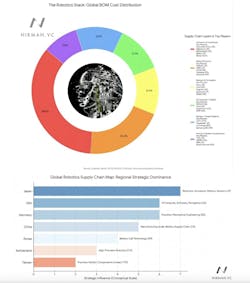
So, before we can figure out who's in charge, we need to know what makes a robot tick. When we break down the cost of all the parts that go into a robot, we see that it's a pretty complicated mix of things, with a lot of heavy-duty engineering involved. According to robotics cost analyses from Boston Consulting Group and McKinsey, actuators and motion components account for the largest share of industrial robot costs.
Here is the cost breakdown:
1. Actuators & Gearboxes (35-40%): The physical muscle. This is the largest single cost center.
2. Robot Structure / Manipulators (15-20%): The physical frame and integration.
3. Sensors & Perception (10-15%): The eyes and ears.
4. AI Compute / Control (10-15%): The operational brain.
5. Battery / Power Systems (10-15%): The energy storage for mobile units.
6. Precision Motion Components (5-10%): The delicate linear components required for fine movements.
This list shows that a robotics breakthrough isn’t just a software triumph; it depends on massive physical components and the supply chains that produce them.
Part 1: The Three High-Alpha Chokepoints (The Real Bottlenecks)
When we looked at the global supply chain, we were focused on identifying chokepoints —components that are both critical and highly centralized in their manufacturing. If these three pillars are constrained, the entire mass adoption of humanoid robotics fails.
Chokepoint #1: Precision Reducers (The Torque Trap)
Who Controls It: Japan
The Truth Is: Robots can't move with a lot of power and precision without special parts called harmonic and cycloidal reducers. Two companies in Japan, Harmonic Drive and Nabtesco, make about 70% of these parts used all over the world (ResearchInChina). Just spending more money won't allow other companies to make these parts, because they need special knowledge about metals and years of experience making precise parts.
Chokepoint #2: AI Compute (The Embodied Intelligence Standard)
Who Controls It: USA
The Reality: Today's robots, especially those that use reinforcement learning and complex perception, need powerful computers to work properly. NVIDIA's CUDA system, along with their Jetson and Thor chips, has become the leading platform used by robots that learn and think. Making a better chip is not enough if you can't replace the software that all robotics engineers already use. This software is like a language that everyone understands, and it's hard to change. NVIDIA's system is widely used, so it's difficult for other companies to compete. They would need to create a whole new system, including software, to replace what's already out there. This is a big challenge, and it's not easy to overcome.
Chokepoint #3: Battery Supply Chain (The Mobile Limitation)
Who Controls It: China
The Reality: Robots are changing from big, stationary machines to mobile ones that can move around. This means batteries are now a crucial part of making them work. One company in China, called CATL, controls more than a third of the world's battery market (carboncredits.com). Because China has such a strong grip on the supply chain for advanced batteries, it's creating a big obstacle for companies that want to make mobile robots.
Part 2: The Leaders’ Map vs. The Countries Still Catching Up
The global map of robotics is specialized. Our strategic breakdown of dominance shows a multi-polar supply chain that is difficult to disrupt:
USA: “The "Brain." (software, autonomy, AI compute).
Japan: The "Hardware King." (motors, gearboxes, precision engineering).
Germany: The "Precision Engineer." ( mechanical systems, high-end production).
China: The “Scale & Power." (manufacturing speed, massive infrastructure, battery supremacy).
Taiwan: The "Linear Specialist." ( The linear guides and ball screws essential for motion).
Why Money Isn't Catching Up (The Lagging Economies)
This is where the main problem is: money versus the environment around us.
It's evident that countries like India and Brazil are willing to invest in new technologies. India's National Robotics Mission and Brazil's $4 billion AI Plan are just a couple of examples.
Even in the GCC, we're seeing huge investments in automation, like Saudi Arabian NEOM's billions in automated construction, a $500 billion+ Saudi Arabian "cognitive" mega-city project in the Tabuk province, designed as a futuristic, car-free, zero-emission, AI-driven region powered solely by renewable energy (NEOM). But despite all this spending, there's still a big gap in the data. For instance, India's manufacturing output was a huge $440 billion in 2021 (World Bank), but when it comes to robots in the automotive sector, they only have 148 robots per 10,000 employees (International Federation of Robotics). That's way behind China, which has 470 robots per 10,000 employees (International Federation of Robotics).
So, while the money is flowing in, it seems like the real problem is a lack of expertise and knowledge in how to use these new technologies effectively. Why? Because capital cannot purchase these things overnight:
1. Tacit engineering knowledge: You cannot "buy" the metallurgy secrets needed to rival Nabtesco. That knowledge is passed down through specialized engineering cultures over decades.
2. Software ecosystem lock-In: A GCC budget can build data centers, but it cannot instantly train a generation of engineers to leave the NVIDIA CUDA ecosystem for a theoretical indigenous AI chip.
3. Complex supply integration: We frequently find that the barrier to building an industrial robot isn't sourcing the main motors; it's the Precision Motion Components (5-10% BOM) — the high-end linear guides from places like Taiwan (HIWIN). These require deeply integrated component suppliers.
For these emerging economies, the challenge is shifting. It’s no longer about whether you can afford to use robots. It’s about whether you have the engineering and supply ecosystem to survive the great supply chain fracturing of the next 20 years.
If emerging economies face a knowledge gap, the United States faces a different challenge: maintaining its lead.
America already controls one of the most powerful chokepoints in the robotics stack, the AI compute ecosystem. NVIDIA’s CUDA platform has become the default development layer for embodied AI, meaning many robotics companies worldwide are effectively building on American infrastructure.
But leadership in robotics will not come from software alone. The U.S. must also reinforce the industrial layers beneath the AI stack: advanced manufacturing, precision components, and battery supply chains. If the country loses ground in these physical domains, its software advantage could become increasingly dependent on foreign hardware.
Staying ahead will require more than venture capital. It will demand a coordinated push across semiconductor manufacturing, robotics hardware startups, and domestic supply chains. The race is no longer about who invents the smartest robot, it’s about who controls the ecosystem that makes those robots possible.
Final Perspective
The next 10 years will see a rapid shift from specialized industrial arms to highly generalized embodied AI (humanoids). As this happens, the supply chain will not democratize; it will centralize around those who master the chokepoints.
The U.S. will likely industrialize robotics the same way it industrialized semiconductors and software, which is by leading the innovation stack first and scaling manufacturing later through global supply chains. The U.S. dominates in robotics AI, reinforcement learning, and autonomy software. There is a reason that many of the most advanced robotics startups are U.S.-based.
Money is a means to an end, not the solution to every problem. Emerging economies with large innovation budgets must stop trying to build everything at once. Instead, they should focus on developing deep "know-how" in a few strategic domains. Only by concentrating expertise this way can they become true leaders in the current industrial revolution, rather than remaining large buyers of technology designed elsewhere.
Until they make this shift, they will continue to play catch-up. It's time for them to start creating their own expertise and innovation, rather than just relying on others. By doing so, they can take control of their own destiny and become major players in the global economy.
About the Author
Nikhil Choudhary
Managing Partner, Nirman Ventures
Nikhil Choudhary is a Silicon Valley-based investor and operator focused on technologies modernizing the physical economy. He has spent more than two decades building and scaling businesses across construction and real-asset-driven industries, before turning his attention to early-stage investing in robotics, autonomy, and applied AI systems deployed in real-world environments.
His work centers on under-digitized sectors where productivity, safety, and labor constraints present both structural challenges and long-term technology opportunities. Choudhary’s perspective is shaped by hands-on operating experience, with an emphasis on solutions that perform outside controlled settings and deliver measurable outcomes on job sites, in warehouses, and across industrial operations