Manufacturing Day 2026: Celebrating Spacecraft Innovation and High-Tech Shipbuilding
Manufacturing Day is a good moment to look at where American industrial capacity already exists and where it can grow fastest. Southeast Louisiana has built rockets and ships for generations. Now it is building the autonomous vessels, launch infrastructure, and data-driven factories that come next.
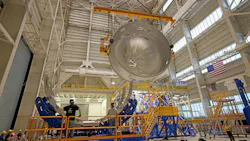
Walk the floor at NASA's Michoud Assembly Facility in New Orleans East, and you would be standing in one of the largest manufacturing plants in the world, with 43 acres under a single roof. Workers there built the first stages for the Saturn V in the 1960s and built the external tanks for the Space Shuttle for three decades. Today, Boeing builds the massive core stage of NASA's Space Launch System at Michoud, and Lockheed Martin builds the crew module structure for the Orion spacecraft, which carries up to four astronauts on missions to the Moon and eventually Mars.
Michoud is the most famous piece of a much larger industrial base. Across Southeast Louisiana, generations of shipbuilders, welders, machinists, and fabricators have supported the energy industry, the U.S. Navy, and the U.S. Coast Guard. Bollinger Shipyards, Edison Chouest Offshore, Conrad Shipyard, and Metal Shark build everything from patrol boats to offshore supply vessels. Textron Systems builds landing craft for the Navy in New Orleans East. Vivace’s work to build the next-generation space station strengthens the region's aerospace capabilities.
That foundation is now attracting a new generation of companies building autonomous systems, commercial space hardware, and AI-enabled factories. These companies need workers who already know how to cut, weld, and assemble large metal structures to tight tolerances. They also need access to shipyards, waterfront facilities, and suppliers that can get the job done.
Autonomous Vessesl and Starbase
Along U.S. Route 90, Austin-based Saronic bought Gulf Craft, a family-owned shipyard in Franklin, and then invested $300 million to expand the site for the production of its 180-foot autonomous vessel, the Marauder. Gulf Craft had 29 employees at the time of the sale, but Saronic has since hired about 300 workers in Franklin and plans to reach 1,500 at full capacity. Down the road in Morgan City, Conrad Shipyard is building a 190-foot autonomous vessel with Boston-based Blue Water Autonomy. Near Lafayette, Breaux Brothers Enterprises is building aluminum Romulus vessels in collaboration with HII, the nation's largest military shipbuilder.
Commercial space is on the same path. In August 2026, SpaceX announced Starbase Louisiana, a $100 billion spaceport in Vermilion Parish that state officials call the largest capital investment in Louisiana history. The state expects the project to create 3,000 direct jobs over the next 10 years. A launch site at that scale will need fabrication, marine transport, logistics, and maintenance support, and the region's aerospace and maritime supply chain can provide it.
Shared Designs and Skills
Autonomous surface vessels share basic design features with the crew boats and fast supply vessels that have served the offshore oil and gas industry for years. Louisiana yards have built those boats for generations, and the same workforce now builds hulls for autonomous fleets. What changes is the innovation that now gets on board and the way the vessels get built.
That shift matters for anyone thinking about the future of manufacturing. Traditional Gulf Coast shipbuilding has required build-in-place work. Today, Saronic is designing its Franklin facility around linear flow, moving material in straight lines and tracking throughput, quality, and labor hours through a manufacturing execution system. The goal is continuous production on a regular cadence. Data and AI tools help make that continuous production possible, but they still depend on skilled people who can read a weld, fix a jig and spot a bottleneck in ways that a computer can’t.
A Supply Chain to Back It Up
Smaller local shops are making the same leap. In St. Bernard Parish, SSE Steel Fabrication, a woman-owned structural steel fabricator, bought its first robotic beam line in 2016 and has since added a fleet of collaborative welding robots and augmented reality headsets for quality control. SSE has agreed to host a pilot with Houston-based Persona AI and Louisiana Economic Development to test humanoid robots on a working shop floor. Persona engineers will study SSE's welders, some wearing motion capture suits, to teach machines how skilled tradespeople move and work. The robots will take on repetitive and dangerous tasks in a trade where experienced welders retire faster than new ones arrive.
In Louisiana's aerospace and defense supply chain, engineers design systems at the region's universities and research centers while fabricators build hulls, tanks, and structures at shipyards along the coast and facilities like Michoud. Companies test rocket engines at NASA's Stennis Space Center, less than an hour from New Orleans, and run sea trials in the Gulf. Deepwater ports and the Mississippi River move finished products to market, and repair yards keep vessels in service for decades.
These industries deliver on the goal of a robust, accessible, and growing middle class. Advanced manufacturing jobs in aerospace, shipbuilding, and defense pay well, often require no four-year degree, and build skills that can last the span of a career.