The Big Productivity Gains Will Come from Cross-Functional AI
Key Highlights
- AI can help bridge manufacturing workforce gaps by automating repetitive tasks, improving defect detection and assisting with training and maintenance.
- Cross-functional AI integration enables complex processes like supply chain management and order-to-cash to become more efficient and less labor-intensive.
- High-quality data, adaptable AI applications and interconnected systems help unlock AI's potential.
- The future of manufacturing AI involves autonomous, coordinated actions across departments, driven by reliable, real-time data and evolving AI models.
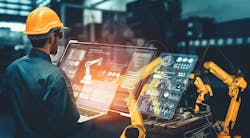
The efficiency and productivity improvements AI could deliver through automation and digitalization could help bridge manufacturing’s workforce gap. Yet fewer than half of AI projects have made it past the pilot phase into production, and despite substantial investments in the technology, its benefits have not generally been obvious in the bottom lines of quarterly reports.
McKinsey describes this dynamic as a productivity paradox akin to that of the PC revolution decades ago. Gartner figures AI is slipping down the hype cycle’s “Trough of Disillusionment.”
Personal computers eventually came through in a big way. All signs point to AI following suit. The paths to enhanced productivity and profitability will probably also run parallel. It took interconnected PCs to end that paradox: Productivity only soared when PCs became interconnected across organizations. Manufacturing will see the same breakthrough with interconnected AI, also known as business AI.
Labor-Saving AI in Manufacturing
In the meantime, AI—and, increasingly, embedded AI—can already help ease workforce bottlenecks with specific solutions already available or coming soon. On the shop floor, predictive-maintenance AI can analyze sensor data to forecast equipment failures and avoid labor-sapping downtime.
AI vision systems can catch defects on production lines at a pace beyond human capabilities and without the repetition-induced fatigue and employee turnover. Collaborative robots (cobots) and automated mobile robots transport material and can assist with assembly and repetitive operations. AI’s coding capabilities extend to CNC and other industrial equipment, speeding up setup time and productivity in hard-to-fill technical positions.
That’s not to speak of AI’s ability to automate and individualize training with or without virtual reality/augmented reality, helping upskill staff whether they’re in the plant or in remote field locations. And AI can enable natural-language querying into knowledge management systems capable of capturing and sharing nuggets of contextually precise institutional memory with unprecedented speed and precision.
The Big Productivity Gains Will Come from Cross-Functional AI
All that said, the interaction of generative AI, agentic AI and machine learning across different areas of an organization holds the greatest promise in solving long-term labor shortages. AI can already let a customer snap a photo of a damaged part and identify it for replacement. Its real power will manifest when AI can also determine the part’s inventory status and locations, establish shipping terms and timing, add the part to the procurement queue to replenish once it’s sold, alert engineering that a design change for a chronic defect may be in order and propose alternative designs.
A current example involving AI across systems: semiconductor company AMD is using generative AI to track down the root cause of delivery delays, simplifying complex supply chain interactions to transform a complex, specialist-dependent, labor-intensive manual process into faster issue resolution and better decision-making. The system cuts the time needed for what was a 14-step process taking 20 to 30 minutes by about 90%, saving more than 3,100 staff hours a year.
AI Is Streamlining Order-to-Cash Processes
Labor-saving innovations are also trimming hours and improving service in the order-to-cash process. Sales quotation support AI can already translate customer requirements from various formats to propose optimal configurations for complex products and equipment.
Coming soon to these intelligent product recommendation engines is an ability to parse what can be 50-page tender documents to extract multiple configurable products for sales quotes. That not only saves time, but also enables junior staff to handle work that has previously required experienced hands.
AI-powered sales quotation support and AMD’s supply-chain troubleshooter – as well as forthcoming AI agents capable of releasing production orders, doing maintenance planning, and dispatching aftermarket field services – all share a degree of interconnectivity that increasingly characterizes AI’s most promising roles in manufacturing. The key challenge for manufacturers is now to establish the digital foundations that enable cross-functional AI.
Manufacturers must build the digital foundations to unlock cross-functional AI. The journey typically involves three steps, though the first two steps typically happen in parallel, with the third step serving as the impetus:
- Create a robust data infrastructure ensuring cleansed, accessible and high-quality data that’s available across the organization.
- Implement applications designed to seamlessly incorporate upgraded AI models as they evolve. Cloud-based applications, for instance, enable a continuous loop of data to feed into AI models automating business processes.
- Adopt AI models as they emerge, from simple task automation to intelligent agents that actively collaborate across the business. These systems won’t just deliver insights, automation, and predictive capabilities; they will also propose, and in many cases execute, autonomous and coordinated actions across the enterprise.
The deeply interconnected business AI of the future will need integrated, easily accessible, reliable, fresh data from sales on through supply chain, production, aftermarket service and product development.
There may be businesses that can avoid building the foundations for business AI. Industrial manufacturers already struggling with staffing enjoy no such luxury. Incorporate AI throughout their organizations will help make it possible for fewer personnel to keep customers happy and production lines rolling.
About the Author
Daniel Krampe
Industrial Manufacturing Solution Expert, SAP
Daniel Krampe is an industrial manufacturing solution expert at SAP.
Gustavo Millan
Senior Director, SAP
Gustavo Millan is senior director, industrial manufacturing and aerospace and defense at SAP.