The 9-Step Roadmap to Reshoring Success

One of our main goals at the Reshoring Initiative is to get manufacturers to stop asking, “Where is labor the cheapest?” and start asking, “Where is total profitability highest?” Many offshore decisions have been made—and still are being made—using incomplete cost models. We advocate that companies shift their thinking from “offshoring is cheaper" to “local reduces the total cost of ownership (TCO).”
Building on these insights, the following nine steps provide a practical framework for achieving reshoring success. Let’s dig in.
Step 1: Identify your imported products that have problems or risks.
Gather input and suggestions from the team. They know which imported products or components have problems that contribute to:
- Stretched and complicated supply chains
- Geopolitical risk that could threaten a company’s survival
- Excess inventory. Morey Corp, a Woodridge, Illinois-based electronic manufacturing services (EMS) company, switched diecast aluminum housing sourcing from China to Illinois and cut inventory by 94%.
- Emergency air freight
- Stockouts and long deliveries. Our 2025 Reshoring Survey showed that 42% of companies would pay 5% to 20% more for one-week (e.g. domestic) deliveries vs. six-week (e.g. Asian) deliveries.
- Quality/rework/warranty issues
- Engineering distance from manufacturing hindering communications
- Delayed product launches
- Intellectual property exposure
- Frequent engineering changes
- Strong regulatory compliance
RI Insight: Some departments—for example, procurement—have been trained to place a high priority on low price. Get inputs from other departments that are impacted by offshoring. Find champions among those who will benefit from reshoring.
Step 2: Use TCO to evaluate the suggested products.
The choice of where to manufacture is no longer based on cheap labor or price alone but rather on a TCO comparison, followed by investment considerations that improve throughput and narrow or close the cost gap. Start by doing the math correctly using our free online Total Cost of Ownership Estimator (TCO).
- Start with products where Ex Works price is up to 30% lower (50% for China offset by high tariffs.)
- Compare the TCO offshore vs. domestic. Call on me for help if needed.
- If TCO is favorable, reshore.
- Hidden costs can outweigh wage disadvantages.
- Consider both in-house production and outsourced components.
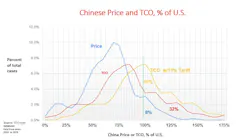
RI Insight: In 190 China-versus-U.S. sourcing cases we analyzed, the U.S. win rate jumped from just 8% based on price alone to 32% using TCO. Add a 15% tariff, and the U.S. win rate rises to 46% (see chart below). But only about 39% of OEMs use TCO, per our 2025 Reshoring Survey.
Step 3: If TCO is within 10%, evaluate automation to improve domestic TCO.
- Calculate the productivity improvements needed to get domestic TCO favorable.
- Consider investment in automated systems to narrow or close the cost gap, eliminate bottlenecks, mitigate labor shortages, automate repetitive or dangerous processes and improve delivery.
- Calculate ROI in terms of TCO, not price. Based on a 30% price or manufacturing cost difference, ROI will be negative. Starting with a 5% TCO difference, ROI will probably be attractive. See a table explaining this logic.
- Achieve automation integration. Coordinate machines, software and control systems into one efficient operation.
- Attend trade shows to discover strategic approaches to optimize production processes.
- RI Insight: Automation, including AI and robotics, helps to close the cost gap compared to competitor countries, enabling more reshoring.
Step 4: Align workforce with any operational changes.
Tech-enabled workers will need to work well in tandem with new automated technologies.
- Invest in continuous learning.
- Ensure supervisors are trained and confident on new equipment.
RI Insight: The goal of human-automation collaboration should not be to replace workers but to create a workforce empowered by technology for optimum efficiency. Eliminating a few workers will not make us competitive. Improving quality, delivery and innovation will.
Step 5: Develop a future-ready manufacturing workforce.
A global transformation is underway. A demographic shift is happening due to an aging population, accelerating advanced technology adoption, supply chain restructuring and reshoring due to geopolitics and uncertainty, and an ongoing critical skills shortage.
- Capture exiting institutional knowledge by implementing formal knowledge-transfer programs like structured exit interviews, job shadowing, video capture of critical processes and searchable digital knowledge systems.
- Identify and define future-critical skills.
- Redesign roles for a hybrid workforce.
RI Insight: The 2025 Reshoring Survey found that skilled workforce was the No. 1 reshoring constraint, ranking far above lower taxes, fewer regulations or even tariffs.
Step 6: Build a skilled workforce pipeline—recruit, attract and retain workers.
A giant wave of retirements is expected to leave up to 1.9 million manufacturing jobs unfilled over the next decade, even before the increased demands of continued reshoring.
- Optimize job descriptions for search engines; for instance, use keywords that candidates would use when job searching online.
- Promote success stories to inspire manufacturing careers.
- Consider competitive benefit offerings like apprenticeships, tuition reimbursement and clear career development paths.
- Support diversity, equity and inclusion (DEI) since it continues to be a key influencer for Gen Z (70%) and Millennials (63%).
- Share authentic manufacturing content through social media platforms, highlighting skilled technician experiences.
RI Insight: View workforce investment as a competitive advantage, not merely a labor expense.
Step 7: Help your customers decide to reshore.
Use TCO to help your B2B customers reevaluate their offshoring and order from you what they have offshored.
RI Insight: Partner with your customers to reshore assembly and components. Our 2025 Reshoring Survey showed that OEMs are more likely to reshore outsourced components than in-house assembly.
Step 8: Tie it all together with leanshoring principles.
Leanshoring is the operating philosophy that enables other success factors to ensure that domestic production is both competitive and sustainable.
- By eliminating waste and improving productivity, manufacturers can reduce total costs while increasing resilience.
- Leanshoring promotes continuous improvement, supplier collaboration and faster innovation cycles to help capture the full benefits of reshoring.
RI Insight: Successful Reshoring = Leanshoring (TCO Focus + Continuous Improvement) + Supply Chain Resilience + Quality + Automation + Skilled Workforce + Proximity.
Step 9: Publicize your reshoring successes.
Tell us about your wins. If eligible, apply for the National Metalworking Reshoring Award. The 2026 winner will be honored on September 17 at 10:30am at IMTS 2026. The application deadline for 2027 is May 31, 2027.
RI Insight: B2C customers will appreciate your reshoring. B2B customers will feel more confident in your support. Your community and employees will appreciate your loyalty and respond in kind.
Are you thinking about reshoring?
Click here [https://reshorenow.org/resources/] to access the full list of Reshoring Resources offered by the Reshoring Initiative. For help, contact Harry Moser at (847) 867-1144 or [email protected]
About the Author
 Harry Moser
Harry Moser
Founder
Harry Moser, founder of the Reshoring Initiative, grew up experiencing the glory of U.S. manufacturing. With more than 45 years of manufacturing experience (most recently 25 years as president, chairman and then chairman emeritus of GF AgieCharmilles), Moser is a leading industry spokesman for reshoring and for developing the skilled manufacturing workforce required by reshoring.
The not-for-profit Reshoring Initiative ‘s Mission is to bring back U.S., and more generally North American, manufacturing jobs by helping companies see that, increasingly, they will be more profitable if they produce and source in or near their market.