US Automotive Tooling 'No Longer Competitive," Says New Study

North America’s once mighty automotive tool-and-die industry has been waning for 30 years, with shops closing, workers retiring and the supply chain moving to Asia. Now the crisis has reached the point that American companies cannot “launch, redesign or refresh vehicles at scale” without Chinese tooling, according to a new white paper released by the Center for Automotive research.
The preliminary research is based on interviews with automotive industry insiders in the past month. Among the findings:
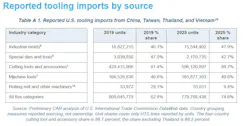
- In 2025, Taiwan, Vietnam and China combined supplied 88.2% of cutting tools and accessories imported to the U.S. China supplied 43.1% of industrial molds, more than double that of No. 2 Canada.
- North America is no longer competitive with China in tooling.
- The U.S. tooling industry has “deep structural problems,” that can only be solved with industry and government collaboration.
- The decline in domestic tooling is both “a national security issue and an automotive competitiveness issue” for the U.S., the report states. Defense contractors use many of the same tooling manufacturers as the automotive industry.
Since the 2018 Section 301 tariffs on China, Chinese tooling imports to the U.S. have declined, while Vietnam’s share of tooling rose from 0.3% to 25.2% in 2025. Mexico has seen similar growth, interviewees said anecdotally, although trade data to back that up is not yet available.
According to the research, China (18.1%), Vietnam (25.2%), Thailand (4.9%) and Taiwan (26.5%) together make up 74.6% of automotive tooling imports to the U.S., as Chinese firms move into those other countries to avoid Section 301 U.S. tariffs.
The study noted several structural problems that the U.S. must address for the tooling industry to improve:
Different payment standards for U.S. and China: Being larger, Chinese tooling firms have more leverage in their payment terms and receive up to 90% of their payments when the goods are shipped—and before the 18-step Production Part Approval Process is complete.
Meanwhile, U.S. suppliers can typically wait three to six months after PPAP until they are paid. The study described delayed payments as the most urgent structural difference for U.S. policymakers and industry leaders to address. Researchers recommended that government and industry collaborate on benchmarking U.S. Department of Defense payment structures to develop a blueprint for tooling payment rules.
Inconsistent pricing standards: Chinese firms bid roughly one-third of North American prices for small dies, and 25-30% below American prices for large dies, the report states. Yet the lower bids do not reflect total lifecycle value—leaving out tariffs, freight, risk, engineering changes and other costs. The industry needs standardized specifications for quotes, say the researchers, while the U.S. must improve customs data and enforcement “so tooling imports reflect full dollar value, origin, classification and route into North America.”
Unavailable subsidies: Chinese tool-and-die suppliers, unlike their U.S. counterparts, benefit from government support and subsidized, low-interest loans that encourage investment in equipment and advanced engineering teams. Growth leads to better bargaining leverage with customers.
Currently more than 100 Chinese tool-and-die shops are over 750,000 square feet, employ at least 1,000 engineers and have the capacity to produce 800 medium and large dies each year, Martinrea CEO Pat D’Eramo told the CAR researchers. Less than five shops in the U.S. have more than 300 employees and a capacity for 150 dies per year.
Shortages of workers and materials: Despite increased productivity, tooling orders in the U.S. can take 15 weeks or longer—the same as in the 2010s. Contributing to delays are a lack of specialized workers to fill available jobs and, with trade-tightening, a reduction in imports to the U.S. of needed materials, particularly P20 tooling-grade steel for mold-making.
The report noted that Canada should be part of any collaboration to improve the U.S./North American tooling industry. Canada’s tool-and-die capability “has been historically significant to North American automotive production” with automotive manufacturing in both countries relying on that integrated cross-border capacity.
About the Author
 Laura Putre
Laura Putre
Senior Editor, IndustryWeek
As senior editor, Laura Putre works with IndustryWeek's editorial contributors and reports on leadership and the automotive industry as they relate to manufacturing. She joined IndustryWeek in 2015 as a staff writer covering workforce issues.
Prior to IndustryWeek, Laura reported on the healthcare industry and covered local news. She was the editor of the Chicago Journal and a staff writer for Cleveland Scene. Her national bylines include The Guardian, Slate, Pacific-Standard and The Root.
Laura was a National Press Foundation fellow in 2022.
Got a story idea? Reach out to Laura at [email protected]