GM CFO: Real EV Improvement Will Be a ’28 Story
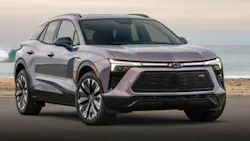
Next year won’t bring big electric-vehicle headlines from General Motors Corp., CFO Paul Jacobson told an investment bank’s conference this week. For marked improvements in the automotive giant’s EV business, investors will need to wait until 2028.
Speaking at Morgan Stanley’s 14th Annual Laguna Conference on Sept. 15, Jacobson said the GM leadership team led by Chair and CEO Mary Barra – who has over the past year and change regularly reiterated that EVs are GM’s North Star for the long term – has made good progress this year on trimming production capacity to match the moment and using some of the company’s cash flow to settle with various EV suppliers.
GM has booked nearly $11 billion in EV-related charges since the middle of last year and Jacobson this summer told investors that figure shouldn’t rise significantly from here.
And now? A bit of a breather.
“So ’27, I think, is going to be a little bit of a sort of flat spot in the EV journey, depending on how much volume we pick up and might get some scale benefits, et cetera,” he told the Laguna conference. The GM team, he added, is “really looking to ’28 to start that step function improvement again and getting there. We still believe EVs are a long-term play for us, and we’ve got to get it right. We’ve got to get them profitable.”
A notable component of that 2028 timeline is the start of production of lithium manganese-rich batteries that GM has developed with LG Energy Solution. When GM and LG Energy officials announced their partnership in May of last year, they said the LMR technology has a 33% higher energy density than top lithium iron phosphate (LFP) cells.
At Laguna, Jacobson said LMR offers “premium and power load at the same cost as LFP.”
 cps_illo_1
 lcid_gravity_3
 rivn_r2_1
“So that will be a stark improvement – thousands of dollars per vehicle at the pack level for new EVs as we start to roll those out,” he added.
GM ranks second in EV market share behind Tesla and has been growing its market share in recent quarters, finishing June with about 13% of total sales. But it will still book a sizable loss from the venture this year, although it will be between $1 billion and $1.5 billion less than in 2025. Hence the need to improve the economics of its batteries as well as other elements of production with an eye to 2028 and beyond.
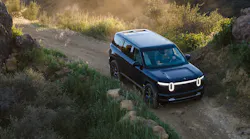
Someone absolutely not looking for 2027 to be a flat year is R.J. Scaringe, the founder, chairman and CEO of Rivian Automotive Inc. Speaking at the Laguna conference a few hours after Jacobson, Scaringe discussed his team’s progress with the R2, a vehicle with a roughly $50,000 price tag that Rivian began delivering to customers in June.
Scaringe told the Morgan Stanley audience that plans remain on track to launch a second shift at Rivian’s Normal, Illinois, plant in the coming weeks. The biggest hurdle in doing so, he said, isn’t Rivian’s own factory capacity or its ability to recruit and train workers but rather to shepherd suppliers on the expansion journey.
“Bringing a second shift on to then not be busy because you don’t have parts is also a challenge,” Scaringe added. “We want to coordinate that really tightly with the ramp-up of the supply chain. But that’s been choreographed really nicely.”
Analysts’ consensus estimates have Rivian delivering 82,000 R2s next year – a big step up from Rivian executives’ estimate that they’ll deliver between 65,000 and 70,000 combined from their R1, R2 and delivery van platforms. Scaringe didn’t commit to that goal but said that R2 is a mass-market vehicle and thus shouldn’t be thought of as competing mainly with Tesla’s Model Y.
“The opportunity is the vast majority of folks who aren't buying Model Y. So that’s folks that are maybe in a Toyota RAV4 or 4Runner [or a] Ford Bronco or Honda CR-V or Audi Q5,” Scaringe said. “It’s the most popular segment in the United States and makes up about half the demand in the United States. […] That was the goal: To bring, call it, regular consumers in, not just early adopters, not just tech adopters.”
So far, so good when it comes to test drives and sales conversions, Scaringe said. And if the Rivian team books wild successes with the R2 next year and beyond, it’ll very likely be because it will have succeeded at breaking many more buyers away from their internal-combustion habits. That will be good news for the EV ambitions of GM as well.
About the Author
Geert De Lombaerde
Senior Editor
A native of Belgium, Geert De Lombaerde has been in business journalism since the mid-1990s and writes about public companies, markets and economic trends for Endeavor Business Media publications, focusing on IndustryWeek, FleetOwner, Oil & Gas Journal, T&D World and Healthcare Innovation. He also curates the twice-monthly Market Moves Strategy newsletter that showcases Endeavor stories on strategy, leadership and investment and contributes to other Market Moves newsletters.
With a degree in journalism from the University of Missouri, he began his reporting career at the Business Courier in Cincinnati in 1997, initially covering retail and the courts before shifting to banking, insurance and investing. He later was managing editor and editor of the Nashville Business Journal before being named editor of the Nashville Post in early 2008. He led a team that helped grow the Post's online traffic more than fivefold before joining Endeavor in September 2021.