China's New Production Strategy Will Put a Dent in US Auto Exports
Key Highlights
- U.S. vehicle exports have been declining since 2019, with the reduction equivalent to two plants' worth of volume and 6,000 employees.
- The current U.S. trade war with USMCA partners Mexico and Canada is exacerbating that decline.
- Any growth in U.S. auto exports in the near term will come from "transplant" plants — German and Japanese automakers increasing exports from their U.S. manufacturing facilities — not the Detroit 3.
- Author Warren Browne predicts a U.S. export sales decline of 16% by 2030 and examines the reasons behind that.
This is the final installment in Warren Browne's three-part series reviewing the potential moves Chinese auto manufacturers could make to avoid duties in North America. Part III focuses on the United States.
Tariffs cannot insulate U.S. light vehicle production from Chinese sales expansion in the Western Hemisphere. Shrinking U.S. export sales just compound the production problem and reduce America’s influence. Required countermeasures to stay competitive seem like a bridge too far for the current United States government.
Chinese Auto Exports and the USMCA: Read the Full Series
Part I: Sizing Up China’s Automotive Strategy in Mexico
Part II: Big Changes in Canada's Automotive Strategy With China
Part III: China's New Production Strategy Will Put a Dent in US Exports
Global Trading: a Brief History
Global trade is a two-way street. All countries import and export goods and services to provide home-market consumers with more variety and businesses with a larger customer base by selling into foreign markets. Make no mistake, exports are an important engine of growth for all economies. The United States recognized this fact as it prepared to lead the globe out of World War II’s economic destruction.
As Peter Zeihan describes in his book “The Accidental Super Power-10 Years On,” “the United States was the only major economy with a customer base large enough to absorb the exports of the defeated.”
The United States’ post-war influence was dominant and required few exports to sustain growth. Zeihan goes on to describe the outcome of the 1944 Bretton Woods agreement, a “deal” that would alter the global trading and financial system for decades.
The U.S. proposed that all major currencies would have their exchange rates pegged to the U.S. dollar, and the dollar would be convertible to gold at $35 per ounce (the official reserve currency). They proposed the establishment of the International Monetary Fund and the World Bank, two groups that would be instrumental in supporting global financial stability. They also agreed to protect the seas to enable the risk-free transport of goods—the default global police that included protection from the Soviet Union. Importantly, the U.S. would import everybody’s goods and services. U.S. exports took a back seat.
All nations agreed to the deal (except the Soviet Union).
This system lasted until 1971, when President Nixon suspended the dollar’s convertibility to gold, breaking the Bretton Woods deal. In the following year, Nixon traveled to China and signed the Shanghai Communique, an agreement that ultimately normalized relations between the two countries. Through it all, exports remained a small portion of the United States economy, 3% to 5% of GDP. Yet, change was coming.
Starting in the 1980s, global trading structure improvements—lower duties, more efficient ocean transport with containers, the free flow of capital and the internet—helped increase the United States’ exports and imports significantly. Result: U.S. consumers had increased variety and lower prices; U.S. businesses had more global customers and more sources of productive inputs.
U.S. exports became more important with the advent of globalization. Other countries wanted American stuff. Since 2000, total exports have averaged 11% of GDP—triple the performance prior to 1980.
U.S. Light Vehicle Exports: Declining Volume and a Shaky Future
The U.S. light vehicle sector contributed to the growth in overall exports. Vehicle exports became an important piece of the overall economy. As late as 2016, U.S. light vehicle exports were 2.25 million units, or 20% of U.S. light vehicle production. That level of production support creates jobs and helps maintain a strong supply chain infrastructure.
Then the wheels started to fall off. By 2019, U.S. light vehicle exports declined to 1.82 million units. The decline continued through last year with exports amounting to only 13% of production, or 1.4 million units. The volume reduction since 2019 is equivalent to two plants worth of volume and 6,000 employees. Recently, export values have been flat, with a significant decline showing up in 2025 (see table below).
Four major factors have contributed to the decline in exports, and the overall decline in U.S. light vehicle production:
- The trade war with China.
- The current trade war with USMCA trading partners.
- Export growth of Chinese vehicles around the globe (major!).
- Production allocation to Mexico.
In 2025, the leading U.S. vehicle exporters outside of the region were BMW and Mercedes-Benz. Toyota, Nissan and Subaru have pledged to increase exports, adding to a growing list of transplant plants shipping units back to consumers in their home countries. Help will also come from the new plants being built by Toyota and Hyundai. GM, Ford and Stellantis have been relatively silent.
In the near-term, transplant plants will help grow export volume outside of the region. Likewise, Mexico’s duties on China-sourced imports should provide a short-term boost to U.S. exports. Unfortunately, U.S. exports to Canada will decline. By 2027, total U.S. exports will represent 12% of production.
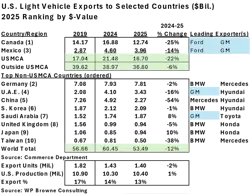
U.S. vehicle export sales are more problematic moving forward. As the previous two articles discussed, China is expected to increase production and sales volume in both Canada and Mexico before the end of the decade. China’s new production strategy (build more units in export markets) will put downward pressure on U.S. vehicle exports. An export sales decline of 16% is projected before the end of the decade (this assumes the Canadian and Mexican vehicle import tariffs remain at today’s level).
Bottom line: Vehicle exports support economic growth and employment. Current support from BMW, Mercedes and Toyota vehicle exports will only go so far. General Motors needs to improve their game, especially in Western Europe. U.S. export policy is different to the one made after World War II. That decision reflected an understanding of the global economic environment; the current administration’s position ignores it. (Exception is U.S. vehicle import duties for the European Union which the U.S. negotiated to zero. This import duty primarily helps BMW and Mercedes).
Higher tariffs may insulate the United States from competitive forces. Yet, tariffs do nothing to improve the competitive position of the home team (Detroit 3 automakers) or increase their exports.
Projected utcome: U.S. exports will decline to 1.2 million units by 2030, or 11% of light vehicle production. Most of the exports will come out of transplant facilities.

What About China-Sourced Vehicles Coming to the USA?
The probability that the United States will allow China-sourced vehicles into the 50 states is extremely low (more like zero). There are two good reasons supporting this conclusion.
The light vehicle sector in the United States will have excess capacity by 2030. In 2025, light vehicle production was 10.4 million units; two-shift capacity could produce 13.12 million. Moving forward, assembly capacity will expand by 2.1 million units given the public plans announced by manufacturers; the most notable are the seven new plants that will come on stream before the end of the decade. The U.S. light vehicle industry will then face a situation where production is 10.95 million and capacity is 15.2 million. That level of excess capacity is not sustainable. Declining exports sales will not help.
The production facilities listed below do not make vehicles today. All are expected to come onstream before the end of the decade:
Ranked in order of potential profitability:
- Toyota Orca Plant (San Antonio)
- Hyundai Ellabell Expansion
- Nissan Canton (former EV plant)
- Ford Tennessee Truck Plant (formally Blue Oval)
- Scout Blythewood
- Rivian Stanton Springs + Expansion
- Slate Warsaw
- VinFast Moncure (very problematic)
These plants need to get started and start making money. Even without an influx of Chinese vehicles, the task will be huge. The probability that all these plants will make money is low. Thus, allowing China to come into the U.S. market before these plants mature would be devastating.
The threat to national security also poses a real risk. China manufacturers also have significant excess capacity. They have incredibly competitive products that are just waiting to be unleased on the American consumer. The U.S. government’s response: protect, protect, protect. Now, the response is realistic. This opinion is supported by both Republicans and Democrats.
Sens. Bernie Moreno (Republican) and Elise Slotkin (Democrat) have introduced the Connected Vehicle Security Act of 2026. Moreno and Slotkin are adamant about not permitting any Chinese vehicles or technology from coming into the United States—from anywhere. Canada, Mexico, Spain and the U.K. should have done the same thing. However, the Trump tariff turmoil has caused those nations to begin to rethink Chinese production in their countries, unfortunately.
The CVSA would codify the restrictions into law. This would put the now Chinese-owned Volvo “Swedish” exemption, granted by the U.S. Commerce Department, at risk.
If approved, the CVSA would make the current tariffs on Chinese vehicles a moot point. However, for the purpose of the most likely scenario, we have assumed the duties remain the singular deterrent (the outlook would be the same if the CVSA passes). Result: China-sourced imports do not exist.
- Lincoln and Buick will stop importing from China (under either scenario).
- Volvo and Polestar volumes would be zero under CVSA. With tariffs, the Commerce Department would have to continue to provide an exemption.
- Waymo would stop importing Zeekr under CVSA.
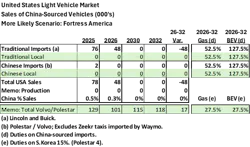
It is reasonable to ask: “What would be the long-term outlook be for Fortress America?” Answer: fewer exports, higher inflation and technical stagnation. Without a clear, consistent U.S. strategy to increase the depth and breadth of vehicle development—electric vehicle performance and cost reduction, battery development, tooling production for vehicles and aircraft and procuring diverse sources of mineral supplies—America will remain in second place.
Pat D’Eramo, CEO of Martinrea International, in a recent interview indicated that America cannot build a car alone—a severe problem caused by a reduction in U.S. tooling capacity and skilled workers. Time for the government to step in and change that paradigm.
Throwing the USMCA agreement out the window will also impede innovation. High tariffs on Canada and Mexico imports just increase the cost for all manufacturers producing in North America; they do nothing to increase affordability. Abandoning the agreement would certainly diminish America’s influence in the Western Hemisphere (China will not stop working to conquest sales in Mexico and South America just because the U.S. has gone to sleep inside the fortress).
Bottom Line: Keeping Chinese vehicles and technology out of the United States is the easy part. Building up America’s automotive competitiveness requires heavy lifting.
A profitable United States vehicle industry requires a diversified supply chain that is predictable. More vehicle exports outside of the region would also help. The U.S. President rejects those hypotheses. The White House needs an influential secretary of transportation that has a little more experience than being on Fox news.
The rest of the world will not slow down waiting for America to catch up.
About the Author
 Warren Browne
Warren Browne
President, RFQ Insights
Warren Browne is adjunct professor of economics and trade at Lawrence Technological University in Southfield, Michigan. He is a retired General Motors executive with global experience, working in six countries over a 40-year career with the automaker.