Big Changes in Canada’s Automotive Strategy With China
Key Highlights
- Canada is broadening its historically conservative outlook on Chinese automotive imports with Trump's hardline tariff policies that are increasing vehicle costs and decreasing autoworker jobs in Canada.
- Now open to negotiations with the Chinese government, Canada has agreed to allow limited imports of Chinese-made vehicles.
- Baseline scenario in Canada is that these vehicles will sell; sales of traditional brands will decline and customers will wait to buy until these lower-cost vehicles arrive.
- Long-term, Canada will gain a wider range of product supply and will have more flexibility in increasing its production, with manufacturing partnerships with newcomers at Detroit 3 Canadian plants.

This is the second article in a three-part series reviewing the potential moves Chinese manufacturers could make to avoid duties in North America. Part II examines possibilities for Chinese vehicle production in Canada. Next week: Fortress America.
Chinese Auto Exports and the USMCA: Read the Full Series
Part I: Sizing Up China’s Automotive Strategy in Mexico
Part II: Big Changes in Canada's Automotive Strategy With China
Part III: China's New Production Strategy Will Put a Dent in US Exports
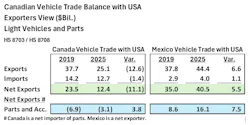
However, Canadian conservatism regarding Chinese sourcing is changing rapidly, given the deterioration in the automotive trade balance with the United States. When compared to 2019, Canada has exported 33% fewer vehicles to the United States. The deterioration in Canada’s exports reflects plant closures, product cancellations, and higher U.S. tariffs.
While Canada remains the United States’ largest export customer, the 10% decline in imports from the United States reflects higher Canadian import tariffs (in response to Trump’s increases) and a slight appreciation of the U.S. dollar. These changes have made U.S.-sourced vehicles less affordable.
Overall, Canada’s trade balance with the United States has deteriorated by $11.1 billion. Mexico’s trade performance has been the exact opposite.
Chinese Vehicle Manufacturers in Canada
Baseline Observations
The double whammy of higher vehicle prices and less production (and jobs) have altered Canada’s view of their automotive trade relationship with the United States. They are more confrontational, specifically due to U.S. tariffs, and President Donald Trump’s May 2025 meeting with Prime Minister Mark Carney where Trump commented, “we want to make our own cars. We don’t really want cars from Canada.” That level of saber-rattling led Canada to look for alternative sources of lower-cost vehicles and more local production. Enter China.
Based on negotiations with the Chinese government, Canada has agreed to a sales quota of China-sourced vehicles starting March 1 of this year. The intent of the policy is to provide Canadian consumers with more affordable battery-electric vehicles. The restrictions of the tariff-rate quota system are severe:
The permits are allocated by Global Affairs Canada on an annual basis. The permits are requested by the importer of record—for example, an entity called BYD Canada Company Ltd. Allocations in the first six months will be on a first-come, first-served basis. This approach will be reviewed by the Canadian government for changes before the second period, which begins September 1, 2026. This first-served system is cumbersome and inconsistent with a solid dealer development process. (Dealers will want to know if they will get a constant supply).
There is a quota limit of 49,000 imported vehicles in the first 12 months at a tariff rate of 6.1%. The quota limit grows by 6.5% each year through 2030. This would imply 65,000 to 70,000 vehicles by the end of the decade. Any China-sourced imports above the quota would pay a tariff of 106.1%.
The quota applies to all versions of electric vehicles: BEV, HEV, PHEV and EREV. (Gasoline versions do not have a quota and receive a tariff of 6.1%).
Canada requires that 10% of the quota must have a customs-value price that is $35,000 CAD or lower. Over time, an increasing share of the quota must be allocated to lower-priced vehicles (50% by 2030). China-sourced imports will not have access to federal incentives.
Baseline China-sourced volumes increase to 80,000 units by 2030, with 10% being gasoline versions. Volvo, Polestar and Tesla would have the highest electric-vehicle volumes early on. BYD, Geely and Chery brands would ultimately surpass their volume. (Note: the allocations by company are still under consideration).
Implications: Chinese manufacturers will sell the quota every year. Current traditional brands would see a sales decline of 80,000 units, losing both electric and gasoline customers. Also, there will be consumers who postpone their purchase while waiting for new China-sourced supply in the following year.
Canadian consumers will welcome these new products due to better pricing and technology. Caution: quota systems typically push transaction prices above MSRP. Shoppers in Toronto, Ottawa and Montreal should visit dealers to learn the actual transaction price.
Long-Term Scenario: Canada Develops a Wider Range of Product Supply
Light vehicle production in Canada has declined by 750,000 units since 2019. That is a substantial number. General Motors, Ford and Stellantis accounted for 100% of the loss; jobs evaporated. In 2025, exports to the United States declined by 10% due to increased tariffs. Importantly, recent capacity changes have made future increases in production look very problematic (baseline):
- GM Ingersoll plant is closed.
- GM Oshawa is at one shift (pickups).
- Ford Oakville is at one shift (pickups, Q4 2026).
- Stellantis Brampton plant does not have a new product and is currently empty.
The Canadian government needs strong countermeasures to offset these headwinds. Team Canada must become more self-sufficient by broadening its sources of supply. GM and Ford are not helping the cause. Even when Oakville reopens, Ford’s pickup output there will remain limited, as Canadian-built F-250 and F-350 models compete with identical vehicles produced at two U.S. plants. GM is also expected to further reduce Oshawa output once pickup production begins at Orion next year.
Stellantis’ response is more creative. To fulfill their financial subsidy obligations, Stellantis offered to assemble China’s Leapmotor vehicles at Brampton. Canada rejected the proposal. Industrial Minister Melanie Joly stated, “We can’t bring cars in a kit to Canada.” The initial rejection sent a message that Canada would protect Unifor labor and Canadian suppliers.
A revised proposal from Stellantis is likely, particularly considering its recent plant-sharing arrangements in Europe. Stellantis should return with a plan that includes more Canadian content, such as steel, parts and batteries. This first production phase, expected in 2029, would involve a joint assembly agreement to build Leapmotor vehicles alongside Jeep or Dodge variants.
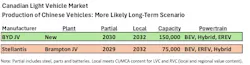
The potential deals for increased production would go beyond Stellantis. BYD could build a new plant by the end of the decade producing at least three products with significant Canadian content. This local production would enhance their expected import portfolio. As with the Stellantis deal, there would be some type of joint venture agreement that ensures Canadian government involvement.
- Both strategies assume that the tariff-rate quota system remains in place through 2032.
- Chinese exports to the United States would be banned or subject to 100% duties.
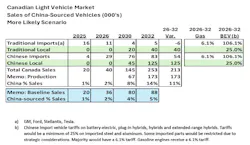
Implications: Canada would benefit from increased jobs when compared to the baseline scenario. Existing manufacturers in Canada would experience an additional volume loss.
However, U.S. exports to Canada would face the largest decline!
Chinese production in Canada would reach 173,000 units by 2032. (Overall Canadian light vehicle production goes up by 145,000 units).
- Brampton plant would be reopened.
- A greenfield plant would add employment.
- Provides the government with leverage during upcoming USMCA negotiations.
- Canadian customers get a wider range of Chinese vehicles.
Canada’s push for more domestic auto production should not stop there. Hyundai sold 25,000 vehicles in Canada in 1984, and stronger sales ambitions led them to open a plant in Quebec in 1989. Although the plant closed in 1993 because demand fell short, Hyundai continued to expand. Last year, Hyundai-Kia sold 250,000 vehicles in Canada, capturing 13% of the market and ranking just behind GM and Ford.
Team Canada recognized Hyundai’s importance to Canada. Their trade mission to South Korea in April discussed a wide range of potential commercial relationships: battery and supply chains, defense manufacturing and potential expansion of Korean automotive investment in Canada. These discussions are likely to lead to more concrete business deals, especially given the uncertainty surrounding USMCA outcomes.
Trump’s insistence that tariffs will fix the United States’ auto problems is leading to a realignment of relationships in North America. Unfortunately, excessive tariffs on trading partners are generating unintended consequences. While final decisions surrounding USMCA are unknown, it is safe to say that Canada is moving to be more auto independent.
Their independence, along with Mexico’s, is driving a clear outcome: Less U.S. vehicle exports to Canada, their largest customer. The irony: The Chinese will negatively influence U.S. light vehicle production levels without selling any units in the 50 states.
About the Author
 Warren Browne
Warren Browne
President, RFQ Insights
Warren Browne is adjunct professor of economics and trade at Lawrence Technological University in Southfield, Michigan. He is a retired General Motors executive with global experience, working in six countries over a 40-year career with the automaker.