Why Starting Your Lean Journey with 5S Can Backfire
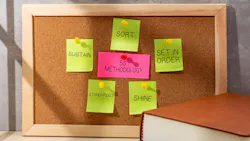




Think twice before starting your organization’s lean transformation with 5S. That’s the message from podcast hosts John Dyer and Dr. Mohamed Saleh in this episode of Behind the Curtain: Adventures in Continuous Improvement. Not a good idea, they say.
It’s not that the duo is against 5S. In fact, they describe 5S as a powerful lean tool, and both acknowledge its attractiveness as a starting point.
“It's visible. It's easy to teach. It's powerful. It's low, low barrier. People are excited and motivated for it,” notes Saleh.
Moreover, says Dyer, “It has the quickest impact of any of the tools, as far as a visual change that people can see within their organization.” It can boost morale, as least temporarily, free up space and improve organization, he adds.
However, the elements that make 5S so attractive also can cause it to backfire as a starting point for lean, the podcast hosts say.
For example, Dyer says the “quick hit” provided by a 5S event as a lean starting point can easily turn 5S into a lean end point as well.
“If you're not ready to follow that [quick hit] up with more things, then what may end up happening is you do the 5S and then stop, and everybody proclaims, ‘Oh, look how much improved we are,’ because it is a great visual impact, but you don't go any further, and … you miss out on all of the other aspects of lean,” Dyer says.
Saleh goes further. He says introducing 5S without other elements in place first (such as a larger strategy, the right leadership behaviors, respect for people, trust) takes a powerful tool and turns it into “cosmetic theater.”
Dyer shares a story in which a poorly implemented 5S effort led to a union walkout and a vow to never introduce shadow boards again.
Saleh discusses the original purpose of tools like 5S. “Workplace organization was supposed to support flow. It was supposed to support abnormality detection. It was supposed to support motion reduction, quality … machine reliability, safety, standard work,” Saleh said.
“It was not intended to be a standalone initiative, ever.”
The two discuss the many ways in which 5S can breed workplace resentment and resistance, including when organizations turn it into a shaming tool or introduce punitive audits. Saleh describes it as “weaponizing” 5S.
"5S without trust becomes becomes surveillance," he says.
Dyer adds that organizations too often introduce 5S to a workforce that hasn’t yet been introduced to lean.
The two conclude the broadcast with an in-depth exploration and outline of the organizational elements they describe as “prerequisites” to introducing 5S.
About the Author
 Jill Jusko
Jill Jusko
Bio: Jill Jusko is executive editor for IndustryWeek. She has been writing about manufacturing operations leadership for more than 20 years. Her coverage spotlights companies that are in pursuit of world-class results in quality, productivity, cost and other benchmarks by implementing the latest continuous improvement and lean/Six-Sigma strategies. Jill also coordinates IndustryWeek’s Best Plants Awards Program, which annually salutes the leading manufacturing facilities in North America.
Have a story idea? Send it to [email protected].