Rugged Two-Way Radios for Demanding Construction Sites
Key Highlights
1. Construction radios must withstand drops, dust, water, vibration and changing temperatures—not simply deliver adequate range.
2. RETEVIS RB48 has passed 19 environmental reliability tests under the MIL-STD-810H testing framework.
3. The new RETEVIS RB48D brings DMR digital communication to the rugged RB48 platform for more complex construction operations.
Rugged Two-Way Radios for Demanding Construction Sites
Construction sites are unforgiving environments for communication equipment.
Radios move between crews, get exposed to concrete dust and rain, operate alongside heavy machinery, and face drops, vibration and changing temperatures throughout the workday. At the same time, workers depend on them to coordinate equipment, materials, subcontractors and changing jobsite conditions.
For construction teams, that raises an important question: What makes a two-way radio reliable enough for a demanding construction site?
The answer goes beyond range. A construction radio must continue working when the environment becomes difficult.
Why Construction Sites Need Rugged Two-Way Radios
A radio used on an active jobsite faces conditions that ordinary communication devices may rarely encounter.
Dust can enter exposed components. Rain and mud can affect equipment. A radio may fall from a belt or be knocked against steel and concrete. Constant machinery creates vibration, while outdoor projects expose equipment to changing temperatures.
There is also noise.
Engines, drilling, cutting equipment and heavy machinery can make a radio technically connected while still making the message difficult to understand.
That is why reliable construction communication depends on several capabilities working together: physical durability, environmental protection, clear audio and dependable day-to-day operation.
RETEVIS’s construction solution identifies structural signal obstruction, device durability, excessive noise and coordination gaps among the major communication challenges found on real jobsites.
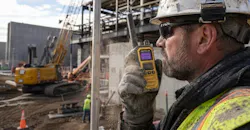
What Makes a Two-Way Radio Rugged Enough for Construction?
When evaluating rugged two-way radios for construction, teams should look beyond a single specification.
Durability and impact resistance
Radios should be designed for repeated handling, vibration and accidental drops common to active crews.
Dust and water protection
Construction sites rarely stay clean and dry. Appropriate ingress protection helps equipment continue operating around dust, rain and mud.
Environmental resistance
Temperature changes and vibration can expose weaknesses that may not appear under normal indoor conditions.
Clear audio
Communication has little value if instructions disappear under machinery noise. Audio performance is therefore part of reliability—not simply an additional feature.
Battery performance
Equipment also needs to remain available throughout the shift rather than becoming another device crews need to manage constantly.
Why MIL-STD-810H Testing Matters
Environmental testing provides a more useful way to evaluate ruggedness than appearance alone.
One example is the RETEVIS RB48, developed for demanding construction and industrial environments.
RETEVIS RB48 has passed 19 environmental reliability tests under the MIL-STD-810H testing framework, including testing involving temperature shock, vibration, sand and dust, and immersion. RETEVIS has incorporated this testing into its broader industrial reliability approach.
RETEVIS RB48 series also incorporates IP67 dust and water protection, supporting use in environments where rain, dust and rough handling are routine rather than exceptional.
For contractors, the broader lesson is straightforward:
Ruggedness should be demonstrated through how equipment is designed and tested—not simply how rugged it looks.
When Construction Teams Should Consider DMR
Physical durability solves only part of the communication problem.
As projects become larger, communication itself becomes more complex.
A small crew may need straightforward push-to-talk communication. A larger project can involve project managers, equipment operators, safety teams, subcontractors and material crews communicating simultaneously.
This is where digital communication can become valuable.
Building on the RETEVIS RB48 series, RETEVIS introduced the RETEVIS RB48D, a DMR industrial digital two-way radio designed for larger professional teams.
RETEVIS RB48D combines rugged construction with digital capabilities including flexible group communication, digital/analog operation and AI-powered noise reduction intended to improve voice clarity around machinery and other background noise.
Rather than replacing ruggedness, digital communication adds another layer to reliability:
the ability to organize communication as the operation becomes more complex.
How to Choose a Rugged Radio for Your Construction Team
Before selecting a radio, construction leaders should ask five practical questions:
● What environmental conditions will the radios face?
● How much dust, water, vibration and physical impact should be expected?
● How noisy are the work areas?
● How many teams or communication groups need to coordinate?
● Does the project require simple analog communication or more structured digital communication?
Starting with these questions helps teams evaluate communication around the jobsite rather than around a product specification sheet.
That matters because every construction environment is different.
16 Years of Learning What Reliability Means
In 2026, RETEVIS marks 16 years of developing communication products around real-world users and operating environments.
Over those years, reliability has come to mean more than making a radio that turns on and transmits.
It means equipment that looks and feels ready for professional use. Communication workers can hear. Products built for demanding environments. Solutions adapted to real operating conditions. And support that continues after deployment.
RETEVIS RB48 and RETEVIS RB48D represent two stages of that same approach: start with the conditions people actually work in, then build communication around them.
Because jobsites may be different, but the expectation remains the same:
Different World. Same Connection. Always Reliable.
