Podcast: With The Post-AI Age On The Horizon, How Are Operations Executives Preparing?
Key Highlights
- AI adoption in manufacturing should focus on improving efficiency and supporting workers, not simply reducing headcount.
- Strong communication, culture and leadership remain essential as operations teams navigate AI, remote work and other disruptions.
- Closing gaps between engineering and production can strengthen handoffs, ownership and the flow of products through manufacturing systems.
- Peer groups give operations leaders a trusted setting to share experiences, ask tough questions and identify practical solutions.
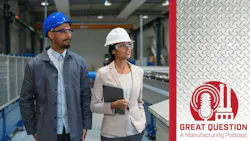




In this episode of Great Question: A Manufacturing Podcast, Chuck Orzechowski and Josh Renicker of the COO Forum discuss how operations leaders are navigating AI-driven disruption and workforce change. They explore the importance of human-centric leadership, strong teams, and culture as new technologies reshape manufacturing. The conversation also examines how closing gaps between engineering and production can support operational excellence at a moment where the post-AI age is on the horizon.
Below is an excerpt from the podcast:
Thomas Wilk: Hi, everyone, and welcome to a new episode of Great Question, a manufacturing podcast brought to you by Endeavor Business Media's Manufacturing Group. I'm Tom Wilk, chief editor of IndustryWeek, and today we're going to talk with members of the COO Forum, which is a peer community that's built exclusively for chief operating officers and senior operations executives. Specifically, the forum provides a trusted space for COOs to gain practical insights, sharpen their judgment, and learn from leaders who have faced similar challenges, leading to clearer decisions and more consistent execution across the business.
The COO Forum is a sponsor of Industry Week's Operations Leadership Summit coming in October, and I couldn't be more excited to have them as a sponsor and talk with two members of the Forum today – Chuck Orzechowski, the CEO, and Josh Reneker, the Director of Ambassador Programs. Welcome, guys. Thanks for being on the podcast.
Chuck Orzechowski: Yeah, great to be here. I think Josh and I, we heard operations and leadership in the same sentence, and with IndustryWeek, we knew we had to be on the call, so great to be here and great to be a sponsor.
TW: We are so pleased to have you as a presenting sponsor of the conference too. And we'll talk about the session we've got that Josh will deliver, later in the podcast here. Maybe we can talk first, guys, about the forum itself. And I'll direct this first question to you, Chuck. Tell our listeners who are unaware of the COO Forum some things about it. How did it get started, and what kind of gaps in industry did you see this forum filling?
CO: The COO Forum was founded by Bill Shepard in 2004 in Silicon Valley. Bill had an amazing executive career. I think he worked in about every C-suite position that there was, and his favorite role was the COO. He had worked for Pacific Linen and NordicTrack and Gap, and after finishing his career, he really wanted to get into the world of consulting. He wanted to do that from a COO perspective, and wanted to find a good group of COOs where he could trade ideas with and work on problems together, and he couldn't find one. CEOs, plenty of peer groups out there for them, but Bill couldn't find one for COOs.
What did he do? Like any good entrepreneur, he started the COO Forum. For 22 years, or I guess maybe even a bit more than that, our sole purpose has been to help operations leaders excel both in work and in career. We provide a network of peer groups all throughout the U.S. and North America, and even members abroad, to give them a place where they can come together, work on real challenges affecting their business and careers. We've been very successful at doing it and thousands of members later we're still at it.
Of course, I was a COO at one point in my career before consulting and coming to the COO Forum, and that was before COVID. If you think of what it's like to be a leader post-COVID, whether it's manufacturing or really any industry, it's gotten so much more difficult and now you layer in AI. Of course, with AI there's no shortage of information, but where do you go to really get good insights from people that are working through those challenges. AI can give you the information, but the real business context and the tough stories, the challenges that sometimes happen along the way, it requires other operations executives that are going through that.
TW: Josh, maybe I can ask you about some of the conversations that you're having with members these days as director of ambassador programs. What kind of conversations are you seeing pop up these days on the mind of the COO?
Josh Renicker: Sure. I get the privilege of also being a member of the COO Forum. So I do lead the member ambassador program and just make sure that members are able to find the value that they're looking for. Everybody comes into the forum with kind of preconceived goals and things that they have set, and each member's actually pretty individualized in the value that they're seeking. My role with the COO Forum with the Ambassador Program is just making sure that those members are looking in the right places, right?
Join the 2026 IW Operations Leadership Summit
The IndustryWeek Operations Leadership Summit brings together manufacturing leaders who are responsible for turning strategy into measurable performance. Register today to connect with peers who are tackling similar operational challenges!
I also participate as a member of the COO Forum and as a seated COO since 2013. I'm one that has been in the same role pre-COVID, through COVID, and now post-COVID. And when I joined the COO Forum in super early 2020, it was just before the whole world shut down. So it's interesting to hear the ebbs and flows of the topics that come up in COO Forum sessions.
Obviously COVID hits and everybody's trying to figure out remote work, right? So remote work was in every session, everybody had it top of mind. And it was all about, how do we support the people in the remote work world, because obviously the technology was just already there. So, people started leveraging the tech that already existed, but it was all about the human-centric piece of leading through something so disruptive.
And now we're experiencing honestly a very similar spirit in AI. Chuck mentioned the AI world, it's super, super disruptive and there's still a lot of head scratching and what's useful, what's noise, right? So it's actually a very similar spirit in leading operations as it was when COVID hit. And it's like, there's so many unknowns in all of it.
But interestingly enough, just like the remote work led back to people, so does AI. What ends up happening in the COO Forum is it turns into a discussion around, “there's this new thing, here's the disruption that we're seeing, here's how it's impacting our people, and how can you help me understand how to support our people?” There's a lot of people that are looking over their shoulder and seeing a robot, right, that are like, hey, I feel like my job is at risk. And we as operations leaders have to lean into that human-centric side, and currently that disruption is AI.
CO: And by the way, figure out the supply chain and the craziness.
JR: That's the easy part, Chuck.
CO: That's the easy part, right?
TW: I was having a talk with a couple of guys in one of the IW Best Plants Award winners this year, and they said that they went to the Automate show exploring the idea of humanoid robots and how mature those robots were. But they came back realizing what they needed was actually AGVs, and other robots that help move things safely around the plant. Is that what you're seeing COOs taking a look at right now, when it comes to AI and that sort of thing?
JR: On the manufacturing side, I would say yes. It's all about efficiencies. I haven't met folks that are trying to reduce headcount. It's more about how can we use this new tech? How can we use things that are coming out to get people excited about manufacturing again? It's like we went through that period where manufacturing was leaving and then it was back, people were reshoring, and all the things and it was just a heavy topic to talk about.
And now I feel like it's been a little bit of reinvigoration. Manufacturing's getting exciting again because we've got new tools that we can try to implement and help people do the work. So yeah, I think there's a good mix there and the looking over the shoulder is a scary thing to be doing, especially when you look over and you see something that you don't understand. So much of it is just trying to wrap your brain around it, but it's moving so quickly that nobody can actually keep up with how fast the tech moves. So it's holding on to the coattails and riding the wave as it comes at us and just making sure that people feel supported through it.
CO: We coined a phrase called the modern execution engine. So we're trying to figure out what that looks like, in terms of scalability, building strong teams, strong people and leaders, discipline execution, and the intelligence use of technology. Like, how do we do that? That's what we're calling the modern execution engine. And we're helping our members get out ahead of that as best they can. Sometimes it's a little catch up, but otherwise we're getting ahead because we're going to be living in a post-AI world soon, similar to a post-COVID world, and so what is it going to look like? And those are also a lot of the conversations like Josh said, you know, around the table. So it's fun to be a part of those conversations, that's for sure.
TW: Yeah, and then again, for me, that's an insight. This is the first time I've heard the phrase “post-AI world,” but that is exactly what's going to happen in five more years. I've got three boys in my house, two that are 13 years old, one that's 15, and they will be living and working in that post-AI world. It's going to be ubiquitous, and they'll take it for granted. It's going to be a tool.
CO: Absolutely.
TW: Well, that's a good rundown of some things that are happening specifically in 2026 for COOs top of mind. What would you say, given both in your long stretch with the COO form, are issues or situations that come up that are evergreen, that your members face and help each other out with.
CO: Yeah, I think either Josh or I could answer that, but I go back to the leadership basics. Those haven't changed. Good communication, understanding people and how to motivate people, how to build strong cultures, how to leverage people on your team and build strong teams. In a lot of cases, the conversation is about aligning with our CEOs as well in terms of what that strategy is. Those leadership skill sets are still very germane to the conversation today.
As much as you get to a point in your career where you think you may have mastered some of those skills, the world is not stagnant. It's very dynamic. How I led before COVID could be very much different and how I have to transform those skills post-COVID. And the same thing is happening with AI, leveraging technology, remote teams, all of that sort of thing. So how do I build strong leaders, strong teams, strong communications? How do I build culture that survives all of that that's scalable? Those are evergreen topics, those are things that I think Josh, we're going to be talking about those things 10 years from now, right? You go back to people and Josh has this term called the messy middle. That messy middle is going to be there, that people are going to be there. And so those are the skill sets that aren't going to go out for sure.
JR: Can I expand on that just a second? The one element that I think is interesting in the season we're in now is with the influx of AI, now leaders are managing six generations, right? We have five generations of humans in the workforce at the moment, and then we've got this brand new baby that's AI that some folks are including that as headcount, right? We're in a super interesting season where, you know, in reality here, we're dealing with six different generations all trying to work together and just the dynamic around culture, I'm glad Chuck brought up the culture piece. That comes up a lot in the COO Forum because it's continually changing. It's this continual navigation of trying to get a new employee to talk to somebody who's been around a few years and just the way they approach work, the way they approach life, the way they approach work/life balance is drastically different. Being able to understand and lean into that flexibility piece, that's another topic that comes up quite often in the COO Forum.
TW: I like how your description on the website says it's a trusted space for COOs to do things like this, right? Because you need to know you can trust your peers for number one, honest feedback, even if it is feedback which talks about sanding off a rough edge or two; but also feedback on what they went through, and a lot of information about how plants are operated that's confidential, right? So you need this space for people just to trade stories and see secrets and best practices in a trusted environment where you can lean on those years of experience.
CO: Yeah, we like to say that our members are our best content. And what that means is that when you get a group of leaders together, whether it's six or 15 in a chapter working on a challenge, the questions are amazing. Those members have spent time with each other, so they understand each person around the table. They understand what's going on in their personal life, which you can't avoid the personal life in your professional life and vice versa, so they understand about that and family. And they understand your business context, and so the questions and the insights, and like you said, sanding off the rough edges, Josh could call out me for, “Chuck, you've got your blinders on again.” “Ah you're right, Josh.” You understand that, because he has that history with us, with those people around the table. And so that's extremely powerful. And that's the strength of having that confidential group to go to that most executives don't have. We're back in our office alone thinking about these challenges and we're often saying, man, there’s got to be a better way. And that better way often is at the end of a great session of questions from your peers, for sure. Especially if Josh is in the room, right? Those tough questions.
JR: I always have questions, always have questions. I wanted to add a little bit again on to what Chuck said there. The spirit of the room in COO Forum sessions, the one word that's very rarely used is “should.” We don't have people that are saying like, you should do this, you should see that. It always starts with, “well, here's where I found, here's the experience I have, here's what I took, here's what I learned, what can you do with that?” You know, it's more like that shared experience that just organically happens in the room, and there's so little shoulding on people, right? If you've heard that phrase before, like, “Don't should on people.” It's funny, we don't have that as a rule in the COO Forum, like we never, we never explicitly said, don't should on people, but that's what organically happens, right? People are leaning in, they want to understand, they want to use the mirror more than anything else, right? Like tell me more, tell me how you're feeling about it, tell me how this impacts you, tell me how this impacts your team. Then it turns into this amazing conversation around these shared experiences, and even if I'm in there and I'm like, this doesn't really apply to me, I walk away with like a whole page of notes of things that I can implement. It's incredible.
TW: This is the reason why I'm looking forward to hosting you and other Forum members at the Operations Leadership Summit. The one two years ago, I had to miss it, I wasn't able to join you guys. But this year, you know, we've built this summit around three tracks – safety, continuous improvement, and technology implementation – in an effort to make it relevant to COOs in any industry. We figured those are the three things that COOs are often facing, to have to balance on a daily basis. And Josh, you'll be presenting at the Operations Leadership Summit this year, correct?
JR: That is correct. I get to close out the event. I'm the last speaker on the last day, so buckle up.
CO: Saving the best for last, right?
TW: And the title of your session is “Operational Excellence Is Built In The Gaps That No One Owns.” And I love that as a closing keynote where it's a really good way to tie up the more granular content for the rest of the event.
JR: I mean, I tend to lead in the gaps, right? Chuck brought up the messy middle. I use that phrase quite often. The dashboards tell me everything else. The dashboards are built around process and built around performance and efficiencies and all those kind of things. It's not built around the handoff. It's not built around the communication breakdown between engineering and production. You know, those are the gaps that I tend to live in and thrive in.
So really that's what my session is going to be about. It's going to be about, looking in the mirror a little bit. Where are those gaps in your organization? Where do you fit? Where do you fill in those gaps? Where do you get your folks? And you know, I tend to think of siloed teams, if we think engineering and production, right, there's generally a gap that kind of bleeds in there. My goal is always to kind of close that gap so it acts almost like a transmission, right? Like as you're shifting gears, you have that period where you've got really good overlap that you know you can shift in that window.
That's what I try to do with the gaps in our organization is, how do I get production to see more of what engineering is doing? How do I get engineering to understand more of what production is doing? So that handoff becomes a longer gap, it becomes a longer piece of the process. And then it becomes more of an ownership piece, then it becomes less of a gap that I need to live in. Then it becomes something that thrives and then it really supports that kind of lean pull toward the end that helps move product through the system more smoothly. That's the way I look at everything I have going on. The job description tells people what to do, I'm there to help them find out where the fringes are and where they can find hiccups.
TW: You reminded me of a phrase often said by a colleague at the University of Tennessee in the reliability department. He says basically every success story at a plant that he sees is founded on a variation of the phrase, “here's how operations and maintenance figured it out.” Here's how they close the gap, right? So your point about working in the gaps really resonates with stuff like that.
JR: Yeah, it's fun, right? And like I'm super human centric, right? I mean, that's just who I am. I want to lean into the human side of the work. And that's where the hard part is, that's where the challenges happen in those gaps, those miscommunications, those frustrations. That's where I want to live. And I frustrate my team a little bit just because I don't show up with answers, I show up with questions. And I carry around a mirror, right? Let's find the holes. Let's find the gaps. And I'm there to ask questions. They come to me with questions, and what they get is more questions from me. So for me, it's how can I use every gap to grow every person, right? Every interaction should be an opportunity to grow the people around me. So yeah, that's what I'm going to bring to the OLS. Hopefully close out with some energy.
TW: That's awesome. Well, Josh, I'm leaving my penalty flags at home, and I'm bringing mirrors instead. That's all you need.
JR: That's all you need.
TW: For more information on the forum, listeners can go to www.cooforum.net; and for more information on the summit, which takes place October 20-22 in Spartanburg, SC, you can go to www.iwoperationssummit.com and I'll put those links in the speaker notes. So Chuck, Josh, thank you so much for being with us today and for being a co-sponsor of the summit this year. We really, really appreciate your support and the Forum’s support.
About the Podcast
Great Question: A Manufacturing Podcast offers news and information for the people who make, store and move things and those who manage and maintain the facilities where that work gets done. Manufacturers from chemical producers to automakers to machine shops can listen for critical insights into the technologies, economic conditions and best practices that can influence how to best run facilities to reach operational excellence.
Listen to another episode and subscribe on your favorite podcast app
About the Author
Thomas Wilk
Editor-in-Chief
LinkedIn: linkedin.com/in/wilkt
Bio: Thomas Wilk joined IndustryWeek as editor in chief in May 2026, following nearly 12 years as chief editor for Plant Services. Previously, Wilk was content strategist / mobile media manager at Panduit. Prior to Panduit, Tom was lead editor for Battelle Memorial Institute's Environmental Restoration team, and taught business and technical writing at Ohio State University for eight years. Tom holds a BA from the University of Illinois and an MA from Ohio State University.