How GlobalFoundries Tames AI For Real Gains
Key Highlights
- Semiconductor manufacturer GlobalFoundries developed three practical AI-based solutions.
- The solutions assist with productivity, quality and maintenance.
- All three solutions are designed for scalability.
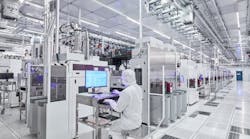
Identifying successful manufacturing AI deployments, such as those in use at semiconductor manufacturer GlobalFoundries, gives us the opportunity to shift the conversation about AI away from large language models (LLMs) like ChatGPT and back onto technologies that inarguably create efficiencies and add value.
MIT in August 2025 reported that 95% of generative AI pilots were failing. That’s not manufacturing-specific but suggestive that the technology itself is the problem, if it fails across the board.
The tried-and-true machine learning/AI-based software used in manufacturing for decades, however, also benefits from today’s more advanced AI. What we wind up with are supercharged versions of existing machine learning-based systems that provide proven value.
Pradip Singh, chief manufacturing officer at GlobalFoundries, shared the stories of three new AI-based tools his company developed that are scalable and, in some cases, already providing ROI.
AI Cracks the Productivity Whip
Singh has responsibility for all five of the company’s fab sites in Singapore, Germany and the United States. His area of expertise is operational excellence, with a focus on using automation to deliver efficiency. He operates out of GlobalFoundries’s flagship fab, fab eight, in Malta, New York.
“Because we run high-volume manufacturing, the sheer number of permutations and decisions that are being made on a daily basis is not something that normal human beings can cope with,” says Singh.
AI, however, is up to some of these tasks.
In 2019, engineers at the GlobalFoundries plant in Singapore took advantage of government funding for automation projects and became a testing ground for innovation. Leadership felt the Singapore plant had many mundane, routine tasks that would lend themselves to automation.
Years later, when Singh reviewed the advancements at the Singapore plant, he found that engineers adopted piecemeal solutions that were often unscalable.
GlobalFoundries established a dedicated digital manufacturing solutions team to assess technology deployments, determine global tech priorities and promote technologies that can be successfully scaled across all its plants.
Here are three successful projects they focused on:
1. Improve RTD Tools
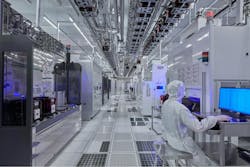
The first project uses AI to greatly improve the speed and accuracy of the RTD (real-time dispatching) software tools GlobalFoundries has used for over two decades. Software developed by deep learning company minds.AI sits on top of RTD and further refines instructions on when to move lots to decrease downtime.
The minds.AI software makes predictions as to when a particular lot will complete and then orders RTD to get other lots in motion and close the “white space” gaps when machines are waiting for new parts and therefore aren’t running.
Singh explains how rapid recipe changes cost precious time at a fab.
“We have processing times that run from five minutes per lot per 25 wafers all the way up to 12 hours,” says Singh. “Now, if you have a 12-hour process, the [silicon] exchange happens once a day, so you lose five minutes. Not a big deal. … [If] the processing time is short because you do a sample, or it's such a quick process, the wafers are in and out, or the tool itself is capable of doing 1,000 wafers an hour—in those cases, the white space is huge. If you can shave off five minutes every 30 minutes, that's another ballgame altogether.”
GlobalFoundries piloted the minds.AI software on only 100 tools at its Malta plant and generated a 1.5% productivity gain. The company in early January 2025 rolled the software out at scale in its Singapore plant, considered an excellent test site for the high number of recipe switches.
“The great part of this system is, we're always changing recipes, bringing in new products, [and] you don't have to retrain it. It trains along the way based on the data … as you improve, as you bring in new products,” says Singh.

2. Inspection Data that Humans Don't Register
Silicon wafers go through extensive and frequent testing during the manufacturing process for film thickness, reflective properties, surface roughness and other impurities. Historically, humans reviewed images to rule out false positives and classify defects. The next step of the review process determined where on the line the error took place.
The Singapore plant several years ago developed and rolled out an AI-based system, nicknamed “Atlas,” trained on millions of legacy silicon scan maps to identify and classify quality issues, identify where on the line the error took place and recommend fixes.
Singh says it takes about six months for people to become comfortable replacing manual scan inspection with the Atlas system, which does things humans can’t justify or make time for.
For example, when silicon scan images were reviewed manually, the reviewers looked for a defect threshold of five. Any scan with five or fewer defects wasn’t classified at all because the silicon passed inspection. Atlas, on the other hand, learns from every scanned image that has at least one defect detected and determines root causes and informs quality managers about these recurring errors.
“It helps us speed up the entire process. It's important for quality, because we want to detect it quicker, obviously. And then, of course, we want to be able to pinpoint where the defects are coming from quicker as well,” says Singh.
Singapore currently runs the third iteration of the Atlas system, which reduced scrap by 20%.
3. AI Agents for Maintenance Technicians
GlobalFoundries will soon roll out a pilot test for another AI-based tool. GF partnered with Lavorro, a company that develops AI and ML solutions for the semiconductor manufacturing industry, to create a new AI-based system for machine troubleshooting.
“Once a tool gets an alarm or an error, the time taken to recover varies,” says Singh. “Why does it vary? We have technicians with different experience. There are some that are really very, very good, that have seen the problem. They've worked with us for 20 years. They know exactly when they see the problem. They know exactly what to do.”
New technicians, on the other hand, may take much longer to make the same repair, owing to their lack of tribal knowledge. GlobalFoundries designed the new AI-based system to address the challenge.
Using five years’ worth of legacy error logs that include machine model numbers and error codes, GF trained an AI model to assist technicians with machine repairs. When a technician enters a model and error code, the AI provides the highest probability root cause and the correct fix, based on the historical error log data.
“It's a living tool … every fix is going to be logged in,” says Singh. “The idea is that the database continues to grow and the answers, the refinement of the answers, become better and better, so you basically have more accurate flow into [the database].
“It's going to take us a couple of years to actually get the full benefit out of it, but when it does … we expect that it's going to give us at least two points of productive time and save a lot of money from changing parts and all that.”
Marrying modern, advanced AI with dependable machine learning algorithms is another logical next step for the technology. Taking that error data and turning it into an agentic AI companion for technicians feels like a no-artificial-brainer.
About the Author
 Dennis Scimeca
Dennis Scimeca
Dennis Scimeca is a veteran technology journalist with particular experience in vision system technology, machine learning/artificial intelligence, and augmented/mixed/virtual reality (XR), with bylines in consumer, developer, and B2B outlets.
At IndustryWeek, he covers the competitive advantages gained by manufacturers that deploy proven technologies. If you would like to share your story with IndustryWeek, please contact Dennis at [email protected].