Agentic AI Could Make Robots Affordable for Small Businesses
Key Highlights
- 70% of a robot's cost cycle hails from engineering and reconfigurations.
- New agentic AI software from Siemens purports to shorten time needed for these modifications.
- Easier reprogramming means less downtime and achieving ROI faster.
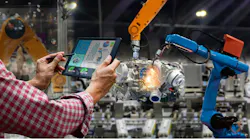
Would you deploy robots at your plant if they could virtually reprogram themselves to perform new and different tasks?
We’re nearly at the end of the AI hype cycle, when suggestions for how to leverage the technology become less flashy and more realistic. Like, for instance, the new agentic AI technology named Eigen, that Siemens revealed at this year’s Hannover Messe automation fair.
Siemens pitches Eigen (a pun as the word means own in German but phonetically sounds like AI gen) as a brand-agnostic AI agent that can replace manual coding or programming for programmable logic controllers (PLC), distributed control systems (DCS) and robotics applications, updating code or instructions to reflect new priorities and goals.
According to Rainer Brehm, CEO of Siemens’ automation business and CTO for Siemens Digital Industries, Siemens in its operations sees that engineering and reconfigurations constitute 70% of the entire lifecycle cost of a robot. If, however, an AI agent like Eigen can shorten the time needed to make these adjustments, it makes the robot more efficient, and SMBs might be better able to afford deploying the technology.
“There’s a kind of new age of automation arising, because [with AI assistance to program robots and PLCs] means you could suddenly automate much smaller lot sizes on a good return of investment,” says Brehm.
Ujjwal Kumar, president of the Americas for Siemens’ Digital Industries Automation, says that Eigen can help manufacturers deal with a lack of coders and programmers.
“We don’t attract the best of the programmers to the manufacturing floor. … So getting programmers to come and code our PLCs or robotic systems? That was a scale up bottleneck. And then add to that, the new generation of people who are coming in, they just know how to do vibe coding. They will not do syntax-based coding anymore,” says Kumar.
“This bringing in AI to reprogram things, reprogram the whole process, will be more game changing in the U.S. than in Germany, where I see when people with Master’s degrees on the manufacturing floor, which is not the case (in the U.S.).”
Humans must always remain in the loop, however, says Kumar. Agentic AI is like an orchestra and humans the conductors.
Eigen obviously has yet to prove itself in the wild, and the jury is still out on agentic AI as a whole. But what Siemens means to accomplish with Eigen feels comparatively banal compared to some of the science-fiction-inspired automation fantasies fueled by AI. Eigen feels down-to-earth and relatively simple.
We’re therefore willing to suspend disbelief and wait for the use cases to roll in. If technology like Eigen does make robotics deployment easier for SMBs, we’ll finally have a use case for agentic AI that might actually change the game, even if just a little.
About the Author
 Dennis Scimeca
Dennis Scimeca
Dennis Scimeca is a veteran technology journalist with particular experience in vision system technology, machine learning/artificial intelligence, and augmented/mixed/virtual reality (XR), with bylines in consumer, developer, and B2B outlets.
At IndustryWeek, he covers the competitive advantages gained by manufacturers that deploy proven technologies. If you would like to share your story with IndustryWeek, please contact Dennis at [email protected].