5S Doesn’t Need a Sixth 'S' for Safety
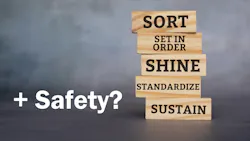



You see this 5S modification in lots of companies practicing lean. Rather than simply embracing 5S as a valuable lean tool, organizations have added a sixth ‘S’ to the tool to represent safety.
That’s unnecessary, say the hosts of the Behind the Curtain: Adventures in Continuous Improvement podcast. Not only is it unnecessary, they say, but it may signal that the organization has a weak safety culture.
In this latest episode, podcast hosts Dr. Mohamed Saleh and John Dyer continue their discussion of 5S, this time with a focus on how it has morphed into 6S with the addition of safety by many.
Saleh leads the conversation by asserting that safety already is embedded in 5S. He says it’s foundational.
“There’s such a heavy emphasis on safety in every single one of the ‘S’s’ that it doesn’t warrant its own S,” Saleh says. For example, “When we look at set in order, that reduces trip hazards. When we look at shine, that exposes leaks. When we look at standardization, that reduces variability. When we look at sustaining that reinforces discipline.”
Safety is an outcome, not a category, he remarks.
Moreover, Saleh suggests that the addition of safety to 5S may have “unintentionally changed the entire philosophy” of 5S. He briefly dips into a history lesson, sharing how Toyota addressed variation by organizing work so that abnormalities would become visible. As lean spread to the United States, 5S or workplace organization morphed into 6S as safety departments in several industries pushed for greater visibility.
Dyer brings another element to the 6S discussion, after first saying, “I just want to say that if you feel compelled to put a sixth S for safety, then by all means do that.”
However, the podcast cohost says that using 6S suggests the organization may have a safety culture problem.
“It tells me that your focus on safety is so poor, so not part of … the fabric of your company, of your organization, that you feel the necessity of adding that sixth S onto a tool that already, like you said, has safety kind of built into it,” Dyer says.
Why not then add S for safety to everything, he adds, citing such examples as the 5 Whys and safety, or Plan, Do, Check, Act, Safety.
“It's almost like saying that we value safety so little or so poorly that we feel obligated to keep reminding ourselves that it's important by adding it to everything that we do,” Dyer says.
Both Dyer and Saleh emphasize that safety is fundamental and should be embedded in all aspects of an organization.
“Maybe the question is whether we ever really understood the purpose of 5S and begin with that, and then also truly, truly reflect as an organization, do we really honor safety, and let's not put it as a slogan, and really try to understand, have we created a safe culture? And if we have, there is no reason to be latching on additional stuff,” Saleh concludes.
About the Author
 Jill Jusko
Jill Jusko
Bio: Jill Jusko is executive editor for IndustryWeek. She has been writing about manufacturing operations leadership for more than 20 years. Her coverage spotlights companies that are in pursuit of world-class results in quality, productivity, cost and other benchmarks by implementing the latest continuous improvement and lean/Six-Sigma strategies. Jill also coordinates IndustryWeek’s Best Plants Awards Program, which annually salutes the leading manufacturing facilities in North America.
Have a story idea? Send it to [email protected].