Battery Scrap Has Become a Critical Resource for US Manufacturers
Key Highlights
- China refines a large share of the world’s cobalt, nickel and lithium, giving Beijing leverage over critical supply chains.
- Export restrictions on antimony in 2024 drove global exports sharply lower and prices to more than four times their historical average.
- Recycled lead supplied an estimated 70% of U.S. consumption in 2025, while recycling remains the country’s only domestic source of refined lead.
- Battery scrap, end-of-life batteries, magnets and manufacturing scrap can supply feedstock for domestic processing.
- The article calls for permanent controls on battery-scrap exports, including spent lead-acid batteries, and for closing circumvention gaps.
The United States lags far behind China when it comes to the manufacture of high-tech batteries, solar panels and communications systems. But even as Washington struggles to catch up in the manufacturing arena, Beijing is also consolidating its hold over the critical minerals that underpin these advanced industries.
In response, Washington is now trying to expand domestic mining and processing. But policymakers still face a self-inflicted wound—the loss of recovered materials and manufacturing scrap that could be used domestically rather than exported overseas.
Strategic Feedstocks, Not Waste Streams
In the past year, the Trump administration has announced steps to jumpstart U.S. mining, including investments in rare earth production and a “Project Vault” to stockpile key minerals. However, the ongoing export of scrap materials—and the subsequent re-import of them as refined products—is deepening America’s overall dependence on foreign processing.
In response, it’s time to make recycling a more prominent part of U.S. industrial policy.
In July, the Trump administration issued a determination regarding recoverable critical minerals and materials (CMMs). In particular, the president noted that the United States “relies heavily on imports of certain CMMs from foreign sources, and this reliance threatens serious, sustained supply chain disruptions.”
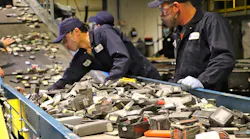
The answer is to treat recovered batteries, manufacturing scrap and other secondary materials as strategic feedstocks rather than mere waste streams. Collecting and processing these materials—including the battery scrap known as “black mass”—can provide domestic sources of materials that would otherwise be exported for processing.
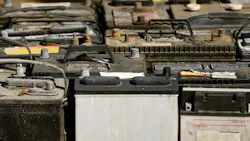
Lead batteries offer a good example. Recycled lead is a key input for new batteries used in transportation, telecommunications, power systems and military applications. In 2025, recycled lead met the equivalent of 70% of domestic consumption. And nearly all of that secondary lead came from recycled batteries. But those spent lead-acid batteries also contain recoverable antimony and tin, making them particularly useful for other industrial applications.
Limited U.S. Refining and Processing
Although the United States isn’t resource-poor, it’s still constrained by limited refining and processing capacity. Contrast that with China, which is expanding its dominance over global refining. It’s estimated that China now refines 73% of the world’s cobalt, 68% of nickel and 59% of lithium.
This leverage can create acute vulnerabilities. Beijing understands this—and happily exploited America’s dependence in late 2024, when it restricted antimony exports. As a result, global exports fell to roughly one-third of prior levels; prices rose more than four times their historical average.
Why is antimony so important? It’s an alloy input with no ready substitute in high-reliability applications. It’s also present in a large share of America’s lead batteries, including those used in military vehicles and telecommunications. That’s why China’s restriction of antimony exports in 2024 quickly hamstrung U.S. industry.
A similar pattern has played out for gallium, germanium, graphite and rare earth metals. In 1995, an Indiana rare earth magnet producer, Magnequench, was sold to Chinese entities. Beijing assured Washington that production would remain in the United States. But the company began moving operations to China in 2001. Since then, the U.S. has spent two decades trying to rebuild its rare earth capacity.
Today, import shortages of key resources have become a real possibility. That’s why recovered and recycled material remain the most reliable domestic supply option. Consider that the last U.S. primary lead refinery closed in 2013, and nearly all domestic lead concentrate is now exported. In 2025, an estimated 1 million tons of secondary lead—nearly all recovered from old scrap and lead-acid batteries—supplied 70% of U.S. consumption. However, America’s net import reliance for refined lead still rose from 27% in 2024 to roughly 33% in 2025.
Recycling now provides America’s only domestic source of refined lead. It also yields one of the few domestic sources of antimony. If the Trump administration wants to ensure that U.S. producers have secure, ongoing access to these key inputs, it should make permanent the Commerce Department’s “black mass” policy restricting battery scrap exports unless a company receives federal approval. The administration should also close circumvention gaps for lithium-ion materials and extend its order to include spent lead-acid batteries as well as battery scrap.
Materials recovered from end-of-life batteries, magnets and manufacturing scrap are the only realistic domestic feedstock for midstream processing capacity in the United States. As such it makes little sense to squander these resources by exporting them to foreign processors—and then buying them back as refined product.
It’s time to change this unsustainable practice before China’s advantage becomes insurmountable. Otherwise, limited substitutes and weak processing capacity will be insufficient to meet America’s future military and industrial needs.
About the Author
 Mihir Torsekar
Senior Economist, Coalition for a Prosperous America
Mihir Torsekar is a senior economist at the Coalition for a Prosperous America. Mihir brings 15 years of experience researching at the intersection of international trade, U.S. industrial competitiveness, and national security. His experience includes 12 years at the U.S. International Trade Commission, where he led multiple statutory investigations examining the effects of foreign trade barriers on U.S. manufacturing, among other topics.
Related
 dreamstime_xxl_149466428