Ford Execs Stick to 2029 EV Breakeven Target
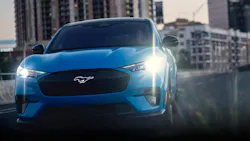
Heading into a year in which they will launch the Fathom pickup truck and invest more in a new energy-store business, the leaders of Ford Motor Co. still expect the company’s electric-vehicle division to break even in 2029.
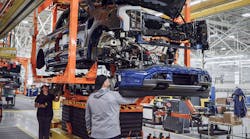
After Ford reported its third-quarter profits of nearly $2.1 billion on revenues of $49.5 billion, CEO Jim Farley and his team told analysts and investors that they are confident the midsized Fathom, which is being priced at about $28,000, can gain traction in an EV market where prices have risen of late. Ford is ramping up operations at its Louisville, Kentucky, plant, where COO Kumar Galhotra said teams have completed 90% of validation testing and cranked out 5,000 unicastings, which are a big part of the company’s strategy to lower costs by reducing vehicles’ number of parts.
Ford’s Model e group posted a loss of $1.1 billion before interest and taxes during the third quarter, which was an improvement from $1.4 billion in the same period of 2025 but slightly worse than Q2’s $919 million EBIT loss. Revenues from the division were down more than 30% year over year to about $1.2 billion as Ford, like its peer General Motors Corp., has cut production to reflect a fall in demand after the expiration last year of certain tax credits for EVs.
 tsla_cybercab_1
 cps_illo_1
 lcid_gravity_3
Customers will be able to start pre-ordering Fathoms, the first vehicle to be built on Ford’s Universal EV platform, early next year but CFO Sherry House said Ford will still be investing heavily throughout 2027. Also calling for lots of capital—about $1.3 billion next year—is Ford Energy, the battery-storage venture housed inside Model e and building a 4 million-square-foot plant in Kentucky that will produce lithium iron phosphate systems. That, House said, means progress toward the 2029 breakeven target won’t be linear.
“We’re now expecting higher expenses in 2027 as the plant’s coming into focus,” House said on an Oct. 28 conference call. “We think that the next step-function change in profitability is going to happen in the first half of 2028 as UEV and Ford Energy both ramp with revenue […] You’re going to see Fathom launching towards the end of [2027] with the first derivative of the platform. Then you’re going to have that full year of production in 2028. Then we’re going to be escalating the Ford Energy business with investment [and have] full-year production also by 2028.”
Ford’s goal of making money (or at least not losing much) from EVs by late this decade has it on a similar path to GM, whose CFO Paul Jacobson said last month that it will be 2028 before GM’s EV financials start to turn a corner in earnest. A key in that forecast is GM’s battery platform of choice, a lithium manganese-rich chemistry it is working on with LG Energy Solution that has a higher energy density than LFP cells such as Ford’s.
Shares of Ford (Ticker: F) were up nearly 4% to $12.43 in midday trading on Oct. 29. Over the past six months, they’re essentially flat and the company now has a market capitalization of nearly $50 billion.
About the Author
Geert De Lombaerde
Senior Editor
A native of Belgium, Geert De Lombaerde has been in business journalism since the mid-1990s and writes about public companies, markets and economic trends for Endeavor Business Media publications, focusing on IndustryWeek, FleetOwner, Oil & Gas Journal, T&D World and Healthcare Innovation. He also curates the twice-monthly Market Moves Strategy newsletter that showcases Endeavor stories on strategy, leadership and investment and contributes to other Market Moves newsletters.
With a degree in journalism from the University of Missouri, he began his reporting career at the Business Courier in Cincinnati in 1997, initially covering retail and the courts before shifting to banking, insurance and investing. He later was managing editor and editor of the Nashville Business Journal before being named editor of the Nashville Post in early 2008. He led a team that helped grow the Post's online traffic more than fivefold before joining Endeavor in September 2021.
Related
 A Ford F-150 Lightning EV truck at the North American International Detroit Auto Show.