Musk and Tesla Target a Big 2030 Milestone
Key Highlights
- Elon Musk is aiming for Tesla Inc. to build 5 million cars annually by about 2030.
- CFO Vaibhav Taneja said sales are being “constrained primarily by production.”
- The company produced about 1.8 million vehicles in the past 12 months.

Elon Musk is aiming for Tesla Inc. to build 5 million cars annually by about 2030 as its teams put to work the capacity expansions being funded by a massive capital spending plan.
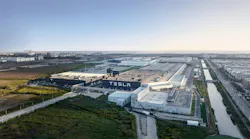
Musk voiced his ambition on Tesla’s third-quarter earnings conference call Oct. 21 and said the company has “a good shot of achieving that goal.” Still, growing to 5 million in the next four years will require a leap that’s big even for Tesla, which has put up some dizzying statistics during the past two decades: The company produced about 1.8 million vehicles in the past 12 months and its production capacity today is a little more than 2.5 million vehicles.
CFO Vaibhav Taneja acknowledged those constraints on the earnings call. While noting that Tesla’s backlog on Sept. 30 was its highest in four years and that the company has now for the first time ever delivered more than 480,000 vehicles in two consecutive quarters, Taneja said sales are being “constrained primarily by production.” In Tesla’s earnings deck, executives called out batteries as being a significant limiting factor but said they had secured extra supplies during Q3.
“We are, therefore, focused on increasing production at all our factories to meet this growing demand,” he added. “While we are actively working to increase production, it does take some time to get every aspect dialed in from supply chain to manufacturing to delivery logistics.”
 gm_chevy_blazer_ev_3
 dreamstime_xl_17265869
Tesla’s leaders are orchestrating a 2026 capex plan that will cost about $20 billion (down from $25 billion, which had been up from $20 billion early this year) and likely will grow in coming years. That spending includes ambitious growth projections for the company’s Optimus robots and energy generation and storage businesses, as well as vehicles such as the company’s core 3 and Y models as well as the Cybercab and Tesla Semi truck, which began volume production last quarter.
Lars Moravy, Tesla’s vice president of vehicle engineering, said on the conference call that the company’s factories are running at record rates this quarter and that his teams are starting to see the benefits of recent expansion investments.
Helping Tesla’s builders in trying to scale rapidly is that the Cybercab has been designed to use half as many parts as other cars the company has built.
“So that’s 50% less things to go wrong,” Moravy said. “We’ve definitely been bursting the Cybercab line to see how fast we can run it. I think the listed capacity is more of a rate at which we’re capable of running today but the actual capacity of that vehicle line is significantly higher.”
Much more automotive expansion is on its way for Tesla: As it is ramping up production of the Cybercab in Texas, it also is looking to add to its factory in Berlin and elsewhere. With that 5 million target in mind, Taneja told investors that “what we are trying to do is literally take over every part of terrestrial transportation.”
Other items of note from Tesla’s earnings report and conference call included:
- Customers are increasingly biting on Tesla’s self-driving software: 75% of North American customers in the third quarter signed on for paid subscriptions, which Taneja said was about 20 points higher than in Q2.
- Musk said most Cybercabs will remain under Tesla’s umbrella as it builds its autonomous transportation business beyond its Austin test bed. But the company also is aiming to sell some vehicles to fleet operators before year’s end.
Shares of Tesla (Ticker: TSLA) fell about 3% to $374 and change on Oct. 22. They are also down about that much over the past six months, which has trimmed the company’s market capitalization to about $1.48 trillion.
About the Author
Geert De Lombaerde
Senior Editor
A native of Belgium, Geert De Lombaerde has been in business journalism since the mid-1990s and writes about public companies, markets and economic trends for Endeavor Business Media publications, focusing on IndustryWeek, FleetOwner, Oil & Gas Journal, T&D World and Healthcare Innovation. He also curates the twice-monthly Market Moves Strategy newsletter that showcases Endeavor stories on strategy, leadership and investment and contributes to other Market Moves newsletters.
With a degree in journalism from the University of Missouri, he began his reporting career at the Business Courier in Cincinnati in 1997, initially covering retail and the courts before shifting to banking, insurance and investing. He later was managing editor and editor of the Nashville Business Journal before being named editor of the Nashville Post in early 2008. He led a team that helped grow the Post's online traffic more than fivefold before joining Endeavor in September 2021.