AI Kaizens Broaden Leadership’s Toolbox at TE Connectivity
Key Highlights
- AI kaizens consider AI first as a possible solution to any problem.
- Scaling, not finding use cases, is now the challenge with AI.
- IT departments must lead the governance of AI developed in the workplace.
If you’re sick of the AI hype and want to see whether the technology is actually worth your time or not, TE Connectivity has a few things to show you.
Jim Tobojka, chief operating officer and senior vice president for global operations at electronic component manufacturer TE Connectivity, is responsible for operations, supply chain strategy, health and safety, global procurement, logistics, several centers of excellence and the company’s strategy for incorporating AI for operations into the company’s networks.
He wouldn’t call the company “AI first.” It does, however, host “AI kaizens” at its plants, to at least always consider AI as one possible solution to any problem.
“The adoption of the technology [that’s] starting to become more available and more stable … people [can] learn it fast and scale it fast. And I think that's when you started to see the hype get caught up to actual practical examples,” says Tobojka.
AI has been part of the company DNA for years. long before the rush of interest following the release of the large language models (LLMs) like ChatGPT at the end of 2022.
“We even had internally at TE what we called an AI Cup, where we brought in interns and college [students], that allowed us to work together to solve real industry-type problems. And we were doing that way before 2022; this was going on even before I came here, and I've been in the company since March 2020,” says Tobojka.
TE Connectivity adopted AI at enterprise scale over concerns about falling behind, but also due to early engagement by engineers and operational leaders. The company saw “heavy engagement” from the plants to try new AI technologies.
The “AI kaizen” events held by TE Connectivity don’t prioritize AI over other approaches. They’re meant to make sure plants don’t miss out on easy wins fueled by AI. In this case, Tobojka shared three practical examples from three different plants.
Three Victories for Manufacturing AI
At one TE Connectivity plant, design engineers embraced no-code, AI-based crimping-tool design software to cut through mundane, manual tasks. Any concerns over AI taking a task out of human hands evaporated to large degree when the utility of the software clearly evinced itself with around $380,000 in savings from one business unit. TE Connectivity expects to deploy the same tool among three more business units in the future and predicts saving around $1.5 million per year when all the systems are in place.
“When you look at what the system can do, [you ask] ‘Is this the most interesting part of where I want to spend my day and time?’ And I think that's what makes AI so powerful. It's agnostic. Wherever you want to spend your time, it will go after the problem,” says Tobojka.
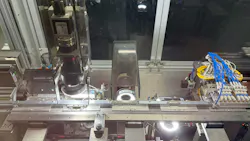
At a plant in Xiamen, China, engineers designed a defect-detection system that employs cameras and vision system algorithms (venerable technology as far as AI goes). The system is 99.99% accurate at detecting errors, according to Tobojka, and the plant saves around $90,000 per annum per machine on the line as a result.
“The Six Sigma approach takes months, if not years, to get to this level, or never. Now you're starting [with AI] to see just the speed of deployment, the speed of improvement and the opportunity to scale this so broadly across your organization; that's what gets people so excited,” says Tobojka.
At a plant in Suzhou, China, engineers developed an AI-based closed loop control system to optimize stitching speed, using real-time machine data. Cycle time reduced by 10% once the system came online.
Paying attention to opportunities like these is precisely what drives the AI kaizens. In some cases, another plant has already developed an AI-based solution for a problem, and Tobojka’s group is responsible for distributing the knowledge.
“This really was grassroots level, and we don't want to stop that,” says Tobojka. We still want people to come up with solutions to problems they're having at their local level. [How] we try to help [is to] prevent them from wasting too much time on solving problems that we already have some pretty good solutions on and allowing them to just pull that [solution] off of the toolkit that we have…which allows us to scale and save money and time and resources faster.”
You Need IT for AI Governance
For TE Connectivity, recognizing the need to focus on the digital transformation element of AI adoption slightly shifted some leadership roles.
“We got somebody who was a technical leader, one of our chief technical officers … he pivoted out of that CTO role, and we brought him into this business transformation role, which helped us create [an] AI innovation team,” says Tobojka.
This extended team, composed of members from TE Connectivity’s worldwide IT network, works on complex AI-related initiatives like designing a private LLM for the company. The larger IT department works on governance and scale.
For instance, the manufacturer instituted a new registration system for AI agents. As employees create new agents, the registration system tracks who’s using what.
“You start to talk about agentic AI, you're talking about thousands of agents doing workflows and processes and creating systems. There needs to be some control pretty fast before it gets out of control,” Tobojka says.
Any time someone designs a new AI agent, that agent requires data, and that data requires governance. Someone has to decide how agents will use data, where that data will go and the cybersecurity hygiene needed. Tobojka says those responsibilities should live in IT.
The Long-Term Bet on AI
In 2024, driven by the need to get ahead of developments in AI, TE Connectivity founded an AI innovation center in Singapore, a global hub with a small team between 12 and 15 people that focuses on pain points, AI-based solutions and the consistency necessary for scaling.
“And I think that's what most companies are having a problem with, not necessarily creating use cases or creating pilots or creating projects. It's about solving a problem and then, ‘OK, this is a problem that I know probably every one of my factories has. What am I going to do to allow this to scale across my business and across my network of plants?’ That's the secret that everyone's trying to fix,” says Tobojka.
TE Connectivity established the center out of a sense of urgency to keep up with rapidly evolving AI technologies. The hope is that eventually operators on the floor will have the same access to the same powerful AI-based tools as everyone else.
“These operators are becoming more and more digitally savvy and equipped. You can start to see the operators interface with these solutions more commonly than in the past. I'm not saying we're ‘there’ inside TE, but that's something that I foresee happening as our operators become more and more comfortable with the technology.”
About the Author
 Dennis Scimeca
Dennis Scimeca
Dennis Scimeca is a veteran technology journalist with particular experience in vision system technology, machine learning/artificial intelligence, and augmented/mixed/virtual reality (XR), with bylines in consumer, developer, and B2B outlets.
At IndustryWeek, he covers the competitive advantages gained by manufacturers that deploy proven technologies. If you would like to share your story with IndustryWeek, please contact Dennis at [email protected].